Advertisement
)

AT A GLANCE
- Concept: Isotope Separation: Dividing uranium into heavy U-238, which does not burn, and light U-235, which powers the reactor.
- Concept: Gas Centrifuge: A fast-spinning cylinder that uses extreme centrifugal force to push heavier atoms to the outer wall.
- Concept: Separative Work Unit (SWU): The exact mathematical metric defining how much mechanical energy is required to enrich uranium.
- Concept: HALEU: Uranium enriched up to 19.75%, remaining just below the legal 20% limit that classifies it as weapons-grade material.
HOW HALEU ENRICHMENT WORKS
Raw uranium pulled from a mine is almost entirely useless for power generation. Over 99% of it consists of Uranium-238 (U-238), a stable, heavy isotope that does not easily split. Only 0.7% consists of Uranium-235 (U-235), the lighter, highly reactive isotope that sustains a nuclear fission chain reaction.
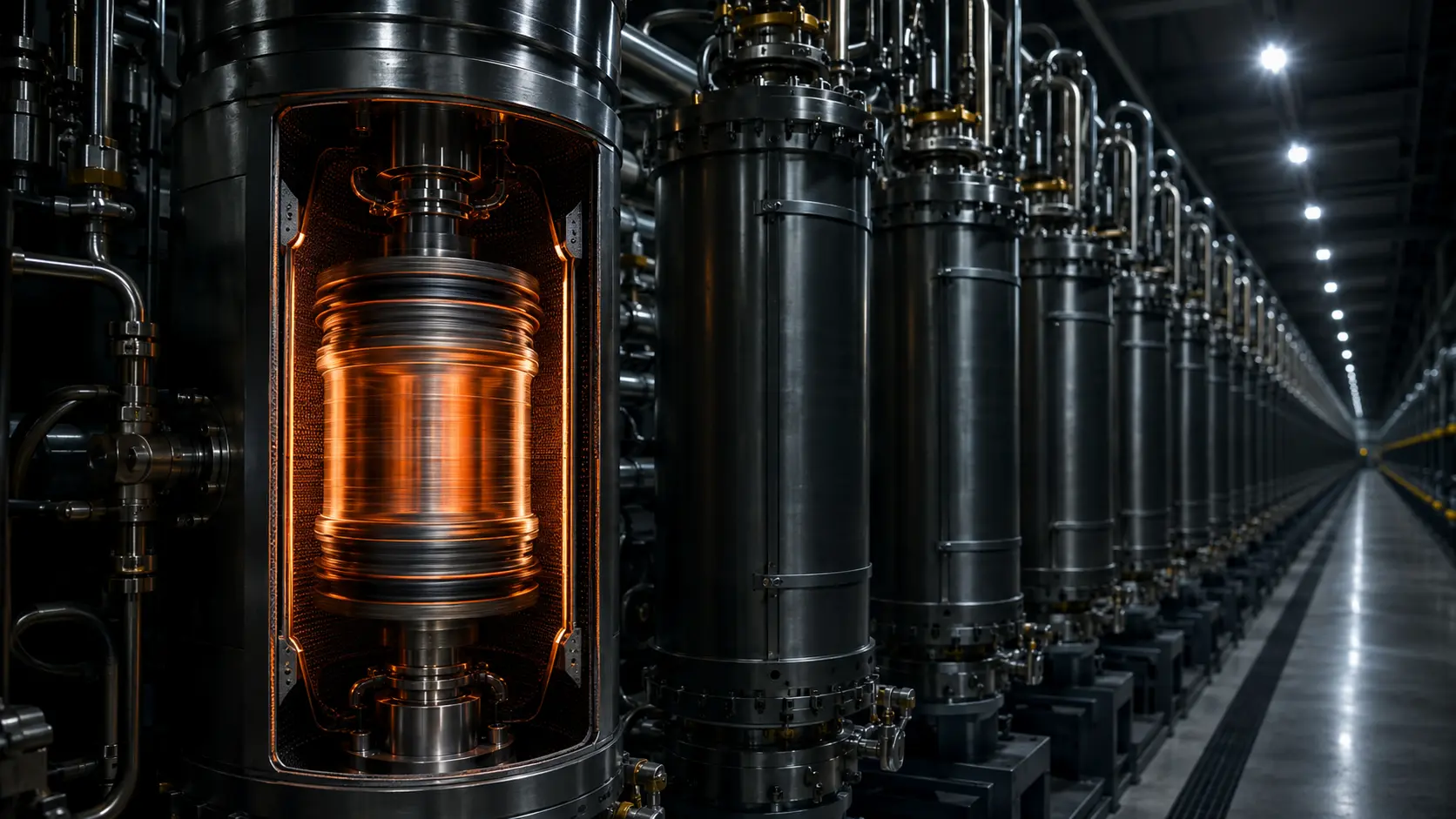
To make this fuel usable, engineers must mechanically separate the U-235 from the U-238, artificially concentrating the lighter isotope. They achieve this by converting solid uranium into uranium hexafluoride (UF6) gas and feeding it into a massive industrial facility containing thousands of spinning cylinders known as gas centrifuges.
Inside a centrifuge, the gas spins at supersonic velocities exceeding 100,000 revolutions per minute. This generates extreme centrifugal force. The heavier U-238 molecules press tightly against the outer wall of the cylinder, while the slightly lighter U-235 molecules remain closer to the physical center. Small scoops at the top and bottom of the cylinder collect the separated gas streams.
A single centrifuge can only enrich the gas by a fraction of a percent. Therefore, engineers link thousands of centrifuges together in a complex, sequential plumbing network called a cascade. The slightly enriched gas from the first machine feeds directly into the second machine, repeating the exact same physical separation process hundreds of times until the final product reaches the target concentration of U-235.
WHY IT MATTERS NOW
The nuclear industry is executing a total architectural pivot toward Small Modular Reactors (SMRs) and advanced micro-reactors. Traditional, massive light-water reactors run on Low-Enriched Uranium (LEU), hovering around 4% concentration. SMRs, designed to be small, mobile, and run for decades without refueling, require significantly denser fuel to operate efficiently.
This denser fuel is High-Assay Low-Enriched Uranium (HALEU), defined as uranium enriched between 5% and 19.75%. The global transition to advanced nuclear energy is currently entirely bottlenecked by the physical inability to produce this specific material.
Historically, the commercial enrichment market optimized its cascades strictly for 4% LEU. Reconfiguring these massive plumbing networks to push the enrichment up to 19.75% requires an exponential increase in Separative Work Units (SWU)—the physical and electrical effort required by the machines. The US Department of Energy calculates that deploying planned SMRs will require metric tons of HALEU annually by the early 2030s.
Currently, the Russian state-owned enterprise Tenex holds a near-monopoly on commercial HALEU production. The geopolitical necessity of breaking this supply chain dominance forces western governments to heavily subsidize domestic enrichment consortiums, such as Centrus Energy, to rapidly construct dedicated HALEU centrifuge cascades on American soil.
WHAT MOST PEOPLE MISS
Non-proliferation analysts often view the 20% enrichment threshold as a simple legal boundary separating civilian fuel from weapons-grade material. They entirely miss the non-linear mathematics of the enrichment process itself.
Enriching uranium from its natural 0.7% up to a 4% commercial reactor grade consumes roughly 70% of the total mechanical effort (SWU) required to make a nuclear bomb. Pushing that same gas from 4% up to 19.75% HALEU consumes nearly all the remaining effort.
Once a facility possesses 19.75% HALEU, the mechanical work required to push that gas up to the 90% weapons-grade threshold is mathematically trivial. A commercial HALEU cascade is functionally indistinguishable from a weapons cascade, requiring extreme international oversight, cryptographic mass-balance tracking, and immediate shutdown protocols if the plumbing is ever covertly reconfigured.
THE TRAJECTORY
Next 12–36 Months: Western enrichment operators will activate the first commercial-scale HALEU demonstration cascades. These facilities will run entirely on government off-take agreements, building the initial strategic stockpile required to fuel the first generation of advanced reactor prototypes.
Next Five Years: The integration of laser isotope separation (LIS). Commercial consortiums will deploy advanced lasers tuned to the exact absorption frequency of U-235. This technology will bypass the mechanical stress of spinning centrifuges entirely, instantly ionizing the target isotope and drastically lowering the cost per SWU.
Next Ten Years: Complete civilian fuel cycle domestication. The US and EU will achieve absolute sovereignty over HALEU production, severing all reliance on Russian enrichment capacity. Modular centrifuge cascades will be co-located directly alongside advanced fuel fabrication facilities, streamlining the highly classified transportation logistics of 19.75% uranium.
What Could Go Wrong: Severe hydrofluoric acid breaches. Uranium hexafluoride reacts violently with normal atmospheric moisture to create highly toxic, corrosive hydrofluoric acid. If a high-pressure cascade pipe ruptures, the resulting chemical cloud can instantly kill facility operators and severely damage the sensitive, high-speed carbon fiber centrifuge rotors.
Most Likely Outcome: HALEU will become the standard fuel matrix for all next-generation nuclear power. The extreme energy density provided by 19.75% enrichment mathematically enables the small physical footprints and long operating cycles required to deploy nuclear reactors at an industrial, decentralized scale.
KEY TERMS
- Isotope: Atoms of the exact same chemical element that possess different physical weights due to a varying number of neutrons in the nucleus.
- Gas Centrifuge: A high-speed rotating cylinder that physically separates heavy and light isotopes by applying extreme centrifugal force to a gas.
- Separative Work Unit (SWU): A complex mathematical unit measuring the total mechanical and electrical effort required to separate uranium isotopes.
- Uranium Hexafluoride (UF6): A solid chemical compound that conveniently turns into a gas at relatively low temperatures, allowing uranium to be processed in centrifuges.
- Cascade: An extensive, sequential network of connected centrifuges designed to incrementally increase the concentration of a target isotope.
SOURCES
- World Nuclear Association — Uranium Enrichment and Separative Work Unit Calculations
- Department of Energy (DOE) — The High-Assay Low-Enriched Uranium (HALEU) Availability Program
- International Atomic Energy Agency (IAEA) — Non-Proliferation Safeguards and Gas Centrifuge Cascade Reconfiguration
- Massachusetts Institute of Technology (MIT) — Advanced Nuclear Fuel Cycles and HALEU Supply Chain Economics