Advertisement
)

AT A GLANCE
- Concept: Solid Electrolyte: A ceramic sulfide matrix that conducts lithium ions without using flammable liquid solvents.
- Concept: Lithium Metal Anode: Pure lithium used to maximize energy, replacing heavy graphite carbon structures entirely.
- Concept: Critical Current Density: The mathematical speed limit for charging before metallic lithium forms destructive, needle-like structures.
- Concept: Interfacial Voids: Microscopic gaps between the solid metal and ceramic where extreme electrical stress concentrates.
HOW A SULFIDE SOLID-STATE ELECTROLYTE WORKS
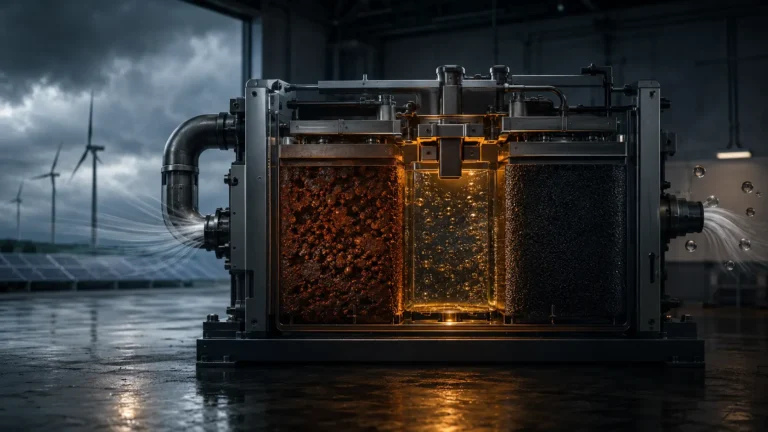
Traditional lithium-ion batteries rely on liquid electrolytes to ferry ions between the positive and negative sides of a cell. This liquid is highly flammable and physically limits how much energy the battery can hold. Solid-state architectures replace this liquid with a rigid, non-flammable sulfide glass-ceramic matrix.
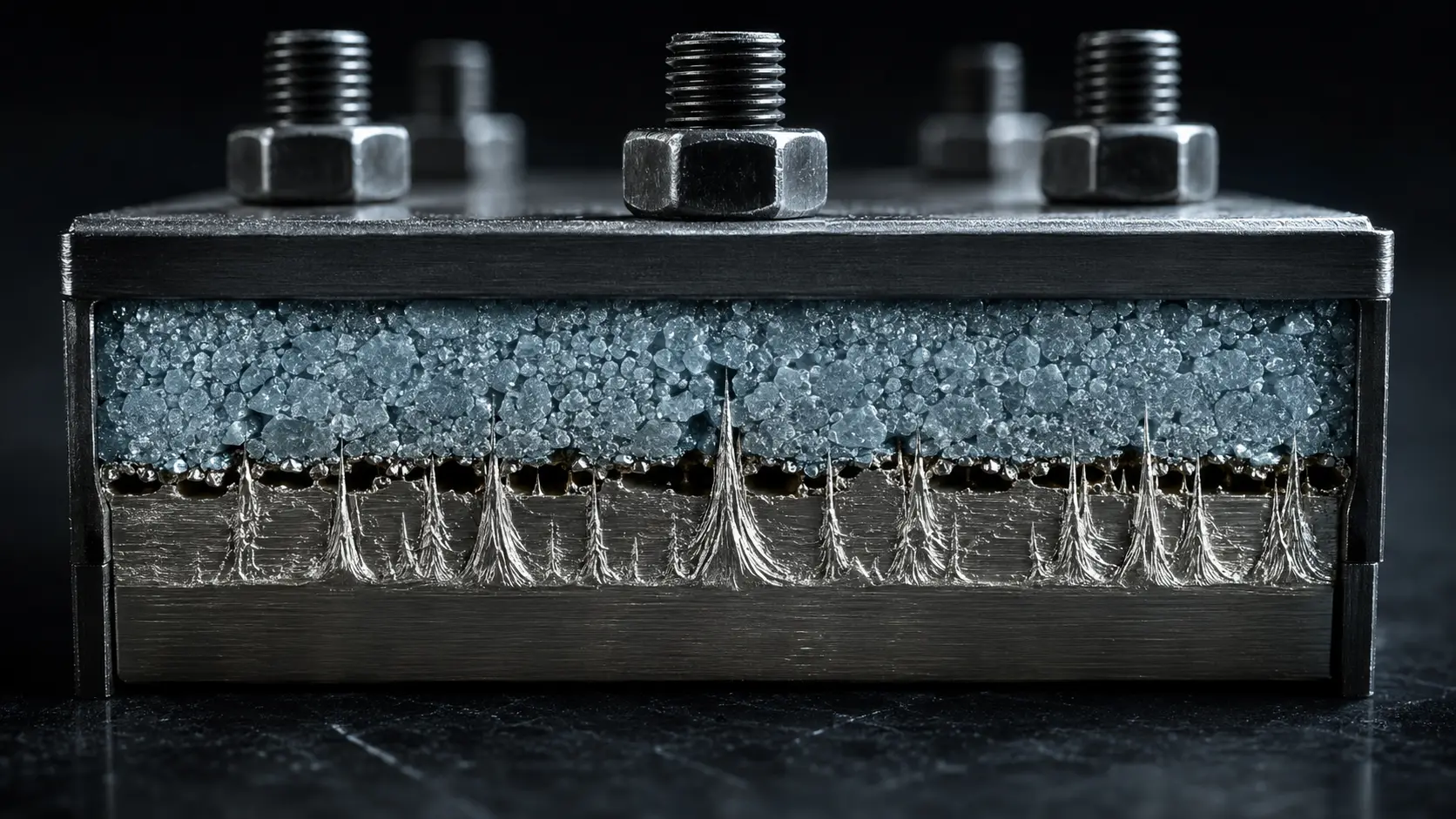
This advanced ceramic allows engineers to swap the traditional bulky graphite anode for a pure lithium-metal anode, massively increasing the total energy density. However, mating two completely solid materials creates a severe mechanical challenge. When a battery charges, lithium ions travel through the sulfide ceramic and deposit onto the solid lithium-metal anode.
Because neither surface is perfectly flat at the atomic level, microscopic gaps or “voids” naturally form at the boundary where the two solids meet.
These interfacial voids act as physical bottlenecks for the electrical current. When a driver plugs an electric vehicle into a fast charger, billions of lithium ions rush toward the anode simultaneously. Instead of spreading evenly across the metal surface, the current concentrates intensely at the few points where the ceramic and the metal physically touch.
This localized electrical bottleneck forces the critical current density to spike wildly. When the current density exceeds the mechanical yield strength of the sulfide matrix, the lithium stops depositing as a flat sheet.
The metal begins rapidly growing as a sharp, crystalline needle known as a dendrite. This metallic needle physically fractures the ceramic separator, bridging the gap between the positive and negative electrodes and eventually short-circuiting the entire battery.
WHY IT MATTERS NOW
The global automotive industry has bet hundreds of billions of dollars on solid-state batteries to solve the electric vehicle range paradigm. Major manufacturers view the sulfide electrolyte as the only viable path to producing a car that drives 700 miles and recharges in ten minutes. If the underlying dendrite physics remain unsolved, these highly publicized production timelines will permanently stall.
To suppress these dendrites, battery engineers currently apply extreme mechanical pressure to the outside of the cell. They wrap the battery in heavy steel frames and use industrial clamps to compress the sulfide ceramic against the lithium metal at pressures exceeding 50 atmospheres. This brute-force physical clamping forces the two solids to mate perfectly, eliminating the microscopic voids and keeping the current density uniform.
However, this massive external clamping infrastructure severely penalizes the primary advantage of the solid-state architecture. The heavy steel casing adds significant dead weight to the vehicle chassis, negating the energy density gains achieved by removing the graphite anode.
Automakers face a brutal physics constraint where a bare solid-state cell holds record-breaking energy, but the final, fully clamped commercial battery pack barely outperforms legacy lithium-ion. Resolving this engineering paradox dictates the financial viability of next-generation manufacturing platforms.
Consequently, the financial winners in the next decade of battery manufacturing will not be the chemical companies that invent the best ceramic powder. The market will heavily reward the mechanical engineering firms that design lightweight, adaptive compression systems capable of managing interfacial pressure dynamically as the lithium metal physically swells and shrinks during every charge cycle.
WHAT MOST PEOPLE MISS
Clean-energy commentators frequently assume that because ceramics are physically hard, they naturally block soft lithium metal from pushing through them. They entirely miss the electrochemical reality of grain boundary vulnerability within the sulfide matrix.
A solid-state sulfide electrolyte is not a single, continuous sheet of glass; it is a compressed block of millions of microscopic ceramic crystals. The invisible seams where these crystals meet—the grain boundaries—possess slightly lower mechanical strength and higher electronic conductivity.
When a localized current spike triggers a dendrite, the lithium needle does not pierce the hard crystal itself. It rapidly exploits the microscopic seams, winding its way through the grain boundaries to short-circuit the cell with shocking speed.
THE TRAJECTORY
Next 12–36 Months: Tier-one battery suppliers will release semi-solid batteries as a commercial bridge. These cells will use a sulfide solid electrolyte but retain a tiny percentage of liquid solvent at the interface to wet the boundary, temporarily eliminating void formations without requiring extreme external clamping pressure.
Next Five Years: The commercialization of silver-carbon interlayer architectures. Material scientists will coat the lithium anode with a microscopic buffer layer of silver and carbon. This specialized interface will chemically regulate the deposition of lithium atoms, acting as an electrochemical traffic controller to prevent localized current density spikes even under rapid charging conditions.
Next Ten Years: The realization of true zero-external-pressure solid-state packs. Manufacturing advances in extreme isostatic pressing will allow foundries to fuse the sulfide matrix directly into the lithium metal at the atomic level during assembly. This will permanently eliminate interfacial voids at the factory, allowing automakers to install lightweight, solid-state packs directly into standard vehicle frames.
What Could Go Wrong: Severe moisture sensitivity. Sulfide electrolytes react violently with trace amounts of humidity in the ambient air, generating highly toxic hydrogen sulfide gas. If an electric vehicle using first-generation sulfide cells suffers a catastrophic physical crash that breaches the protective casing, atmospheric moisture could trigger a lethal chemical exposure event for passengers and emergency responders.
Most Likely Outcome: Sulfide-based solid-state batteries will secure absolute dominance in the premium automotive and electric aviation sectors. The sheer mathematical limit of lithium-metal energy density ensures that the industry will successfully engineer around the mechanical clamping penalties to initiate the next era of global electrified transport.
KEY TERMS
- Solid-State Electrolyte: A rigid, non-flammable ion conductor that physically separates the positive and negative electrodes in an advanced battery.
- Lithium Dendrite: A sharp, metallic, needle-like crystal that grows uncontrollably during rapid charging and physically pierces battery components.
- Critical Current Density: The specific electrical threshold at which smooth lithium deposition breaks down and destructive dendrite growth begins.
- Interfacial Void: A microscopic gap of empty space where two solid battery materials fail to make perfect physical contact.
- Grain Boundary: The microscopic, physical seam separating individual crystal structures within a compressed ceramic material.
SOURCES
- Joule — The Role of Mechanical Pressure in Suppressing Lithium Dendrites in Solid-State Batteries
- Nature Energy — Interfacial Void Formation and Critical Current Density in Sulfide Solid Electrolytes
- Department of Energy (DOE) — Solid-State Battery Commercialization and Interfacial Engineering Challenges
- Advanced Energy Materials — Grain Boundary Penetration Mechanics of Lithium Metal in Ceramic Separators