Advertisement
)

AT A GLANCE
- Concept: Flow Architecture: Energy capacity is stored in massive external liquid tanks, completely decoupling duration from immediate power output.
- Concept: Oxidation States: Vanadium uniquely holds four stable electrical states, allowing it to act as both the positive and negative liquid.
- Concept: Proton Exchange Membrane: A microscopic plastic filter designed to let hydrogen protons pass while trapping larger metal ions.
- Concept: Crossover Degradation: When heavy vanadium ions leak through the membrane, the battery suffers severe, permanent self-discharge.
HOW A VANADIUM REDOX FLOW BATTERY WORKS
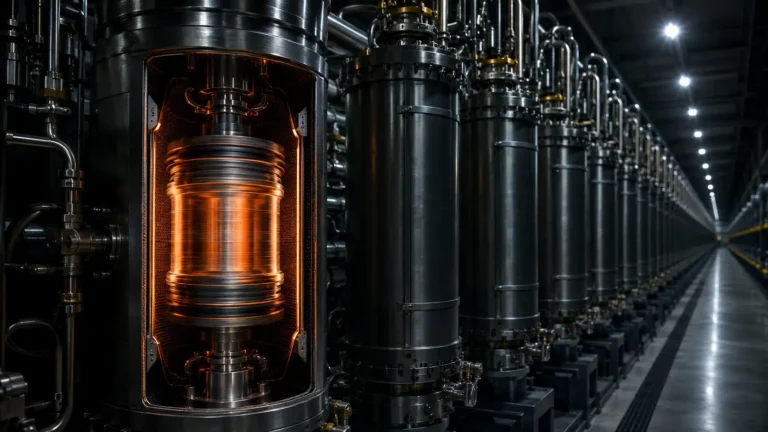
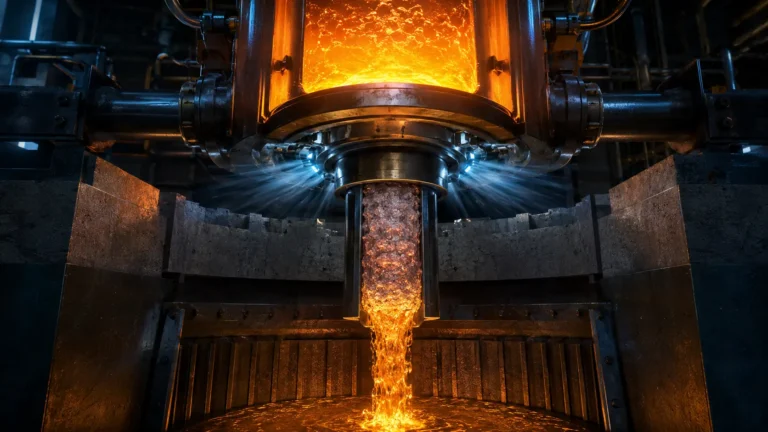
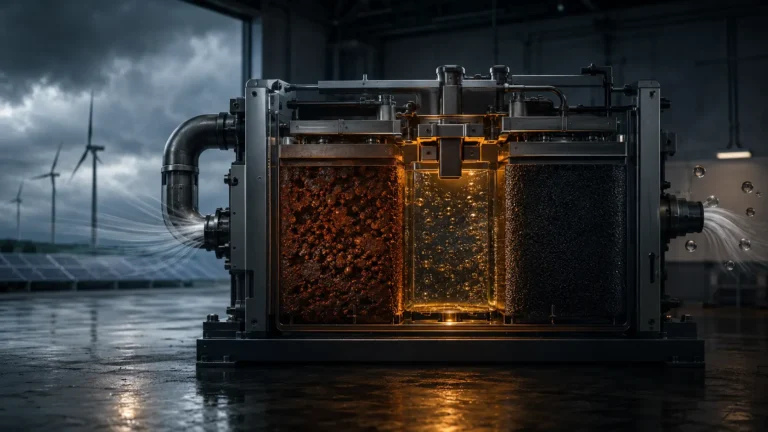
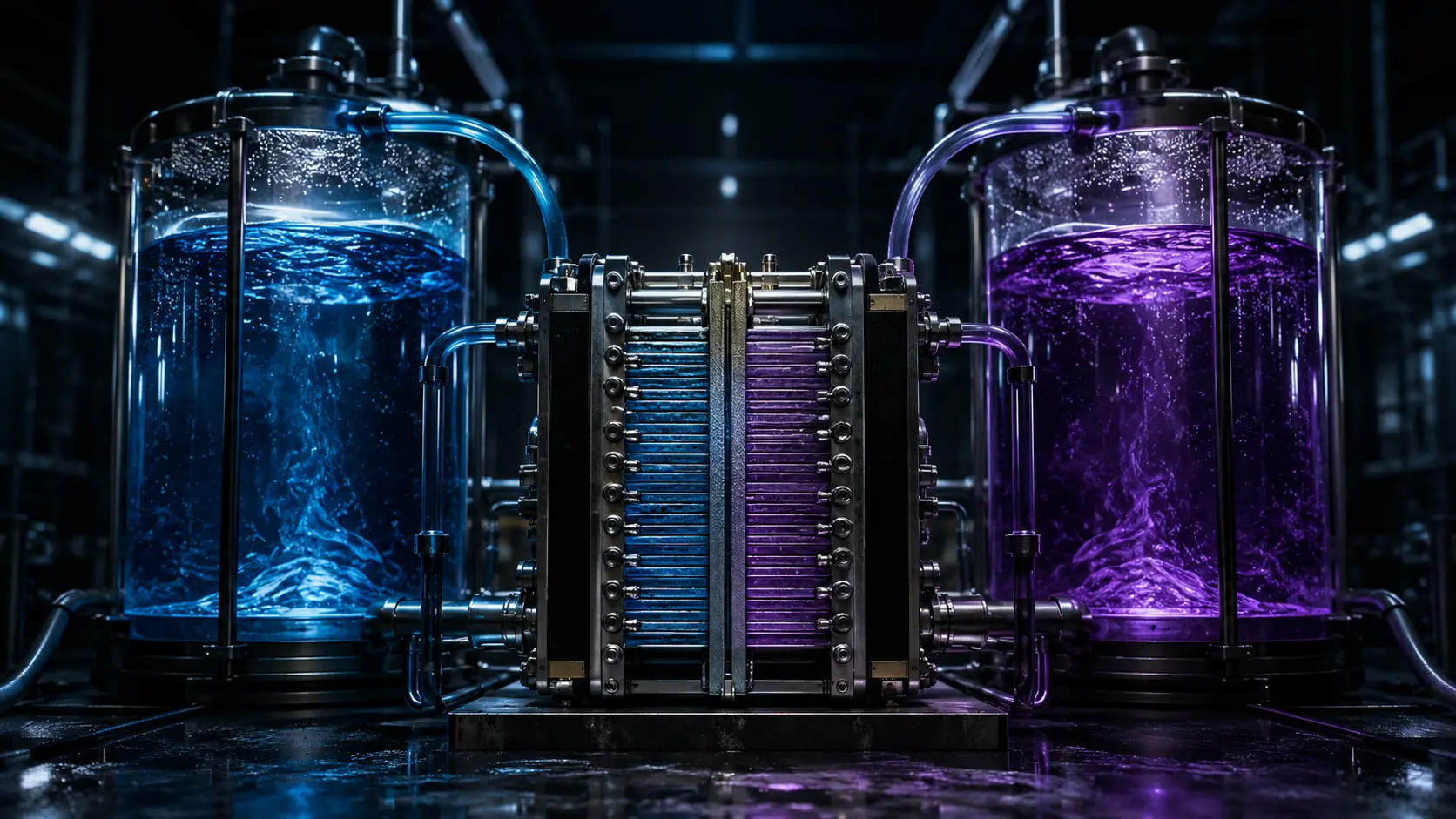
Solid-state batteries, like lithium-ion, force both the energy storage medium and the power delivery mechanism into a single enclosed cell. Flow batteries physically separate these two functions. They pump liquid vanadium electrolyte from two massive external storage tanks through a central, highly engineered cell stack where the actual electrochemical reaction occurs.
The entire system relies on the unique physics of the vanadium atom. Because vanadium can stably hold four different oxidation states (V2+, V3+, V4+, V5+), engineers use the exact same base metal for both the positive anolyte and the negative catholyte fluids. Inside the central cell, these two liquids meet, separated only by a paper-thin proton exchange membrane.
As electrons travel through the external wire to supply electricity to the grid, the internal circuit must physically complete itself. Hydrogen protons must rapidly pass through the membrane from one fluid to the other. Engineers traditionally use perfluorosulfonic acid (PFSA) polymers, which act as highly selective chemical bouncers.
The primary engineering obstacle lies in managing this extreme ionic traffic. The membrane must allow tiny hydrogen protons to slip through the polymer matrix at high velocities while acting as an impenetrable physical wall against the much larger, heavier vanadium ions.
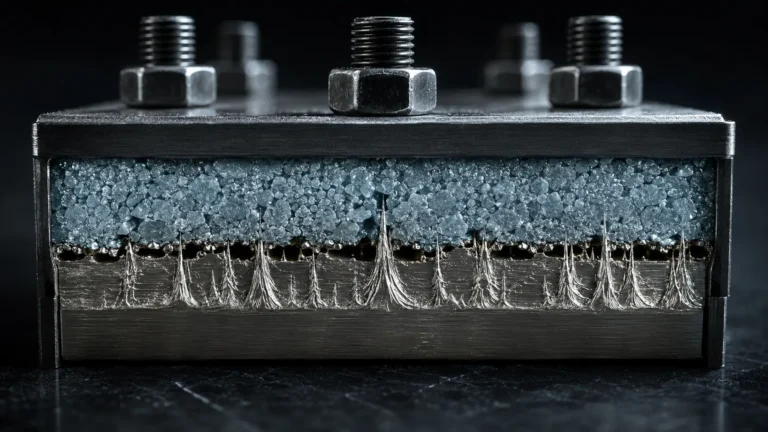
When the polymer fails and allows vanadium ions to slip through the microscopic pores—a mechanical failure known as crossover—the rogue ions immediately react with the opposing fluid. This cross-contamination triggers rapid self-discharge, permanently deleting the stored electrical capacity without performing any useful work for the grid.
WHY IT MATTERS NOW
The modern electrical grid is physically breaking under the strain of intermittent generation. Wind and solar installations require massive, long-duration energy storage to provide baseload power during multi-day weather lulls. Scaling solid lithium-ion arrays to cover a ten-hour discharge window mathematically bankrupts utility providers due to raw material constraints.
Flow batteries provide an unbeatable structural economic advantage. To double the duration of a lithium-ion farm, a utility must purchase entirely new, expensive battery cells. To double the duration of a vanadium redox flow battery, the utility simply buys a larger plastic tank and fills it with more liquid. The power-generating central cell remains exactly the same size.
This extreme capital efficiency only materializes if the central membrane survives long-term operation. Utility financing models demand that grid-scale storage assets operate daily for over twenty years. If vanadium crossover rates remain high, operators face massive operational drag, constantly shutting down the plant to chemically rebalance and purify the contaminated liquid tanks.
To eliminate this maintenance penalty, chemical conglomerates are engineering advanced asymmetrical hemi-membranes. By manipulating the polymer structure at the sub-nanometer scale, they create a directional gradient that actively repels the positive vanadium cations while accelerating proton flow. This suppresses the crossover rate to near zero, stabilizing the battery chemistry for two decades of continuous cycling.
WHAT MOST PEOPLE MISS
Financial commentators frequently dismiss flow batteries because high-purity vanadium commands an expensive upfront commodity premium. They completely overlook the terminal salvage value of the liquid electrolyte.
Unlike a degraded lithium-ion cell, which eventually becomes toxic electronic waste with a negative disposal cost, a vanadium flow battery never degrades its active material. After thirty years, the mechanical pumps and membranes will fail, but the millions of gallons of liquid vanadium remain chemically perfect. The utility can drain the tanks, sell the raw vanadium directly back into the global steel market at prevailing commodity prices, and recoup a massive portion of its initial capital expenditure.
THE TRAJECTORY
Next 12–36 Months: The commercial deployment of heavily cross-linked composite membranes. Manufacturers will embed rigid inorganic nanoparticles directly into the PFSA polymer to prevent the plastic from swelling when soaked in highly acidic electrolyte, mechanically choking off the microscopic pathways that allow vanadium to leak.
Next Five Years: The integration of algorithmic fluid rebalancing. Artificial intelligence systems will continuously ingest telemetry regarding minute crossover rates, autonomously adjusting the physical pump speeds and variable pressure gradients inside the cell stack to force wayward ions back to their correct tanks without human intervention.
Next Ten Years: The realization of multi-gigawatt-hour liquid reserves. Industrial parks and offshore wind terminals will construct sprawling, unpressurized underground reservoirs of vanadium electrolyte. These subterranean tanks will act as municipal power banks, completely isolating regional grids from long-duration fossil fuel dependencies.
What Could Go Wrong: Severe supply chain bottlenecks for fluorinated polymers. The advanced perfluorosulfonic acid membranes required for high-efficiency flow batteries belong to the PFAS family of chemicals. Tightening global environmental regulations regarding the synthesis of “forever chemicals” could artificially restrict the membrane supply, drastically inflating the capital cost of new flow installations.
Most Likely Outcome: Vanadium redox flow architecture will establish itself as the dominant infrastructure for long-duration grid stabilization. The absolute physics of decoupling energy capacity from instantaneous power mathematically guarantees its financial victory over solid-state alternatives at the municipal scale.
KEY TERMS
- Proton Exchange Membrane: A semi-permeable material designed to conduct protons rapidly while acting as an electrical insulator and physical barrier to larger molecules.
- Oxidation State: An indicator defining an atom’s specific degree of oxidation and its exact ability to accept or donate electrons during a chemical exchange.
- Self-Discharge: The internal loss of a battery’s stored energy capacity that occurs silently without any external electrical load being applied.
- Crossover: The physical migration of active metal ions through a battery membrane, resulting in severe efficiency loss and continuous fluid contamination.
- Levelized Cost of Storage: The total lifetime financial cost of building and operating an energy storage plant divided by the total energy it successfully discharges.
SOURCES
- Department of Energy (DOE) — The Economics of Long-Duration Energy Storage and Flow Battery Architectures
- Journal of Power Sources — Mitigating Vanadium Crossover in Perfluorosulfonic Acid Membranes
- Pacific Northwest National Laboratory (PNNL) — Advanced Membrane Materials and Ion-Exchange Kinetics for Redox Flow Batteries
- Electrochemical Society (ECS) — Asymmetrical Membrane Design and Self-Discharge Mitigation in Liquid Storage