Advertisement
)

AT A GLANCE
- Concept: Rotational Inertia: Massive spinning steel rotors physically resist sudden changes in electrical transmission frequency.
- Concept: Reactive Power: Condensers dynamically absorb or generate voltage to stabilize transmission line fluctuations instantly.
- Concept: Short-Circuit Ratio: High fault-current injection prevents inverter-based solar and wind resources from disconnecting during anomalies.
- Concept: Mechanical Decoupling: The rotor spins synchronously with the grid frequency without producing any active electrical megawatts.
HOW IT WORKS
Alternating current electrical grids operate at a strictly synchronized frequency of 60 Hertz (or 50 Hertz in Europe and Asia). This frequency relies entirely on the synchronized spinning of massive turbines inside coal, nuclear, and natural gas plants. When a power plant trips offline, the grid loses supply, and the electrical frequency instantly drops.
The physical weight of the remaining spinning turbines acts as a mechanical shock absorber. Because thousands of tons of steel are already rotating at synchronous speed, their physical momentum resists the sudden slowdown.
The stored kinetic energy in a synchronous rotor dictates this physical resistance, following the equation:
$$E_k = \frac{1}{2} J \omega^2$$
Where E_k represents the stored kinetic energy, J is the moment of inertia of the massive steel rotor, and ω is the angular velocity synchronized to the grid frequency. This stored energy physically buys grid operators the critical milliseconds needed to activate backup power reserves before the grid blacks out.
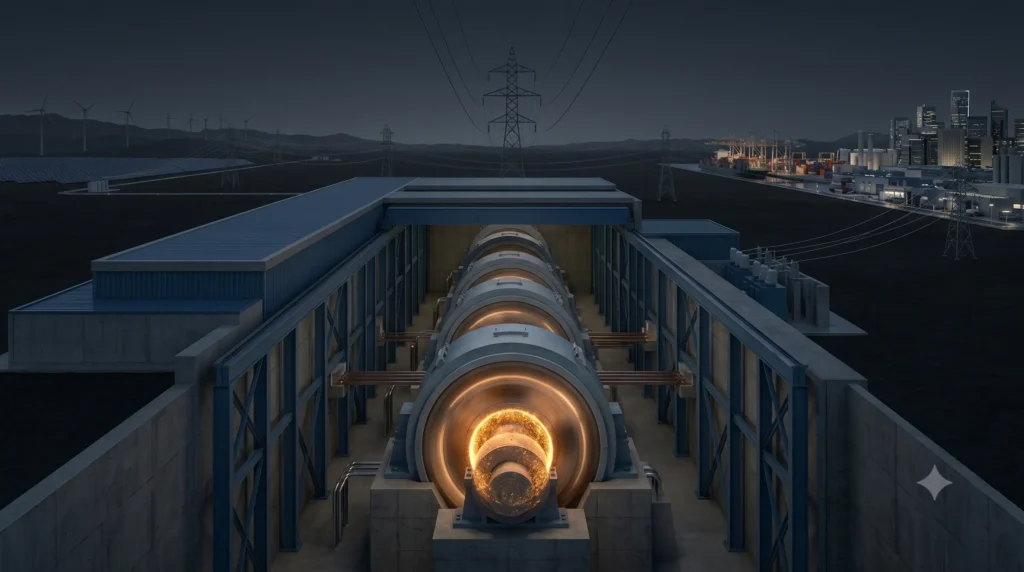
Inverter-based resources like solar panels and wind turbines lack this massive spinning steel. They connect to the grid via digital power electronics, offering zero physical resistance to sudden frequency drops. To fix this physics problem, grid operators install synchronous condensers.
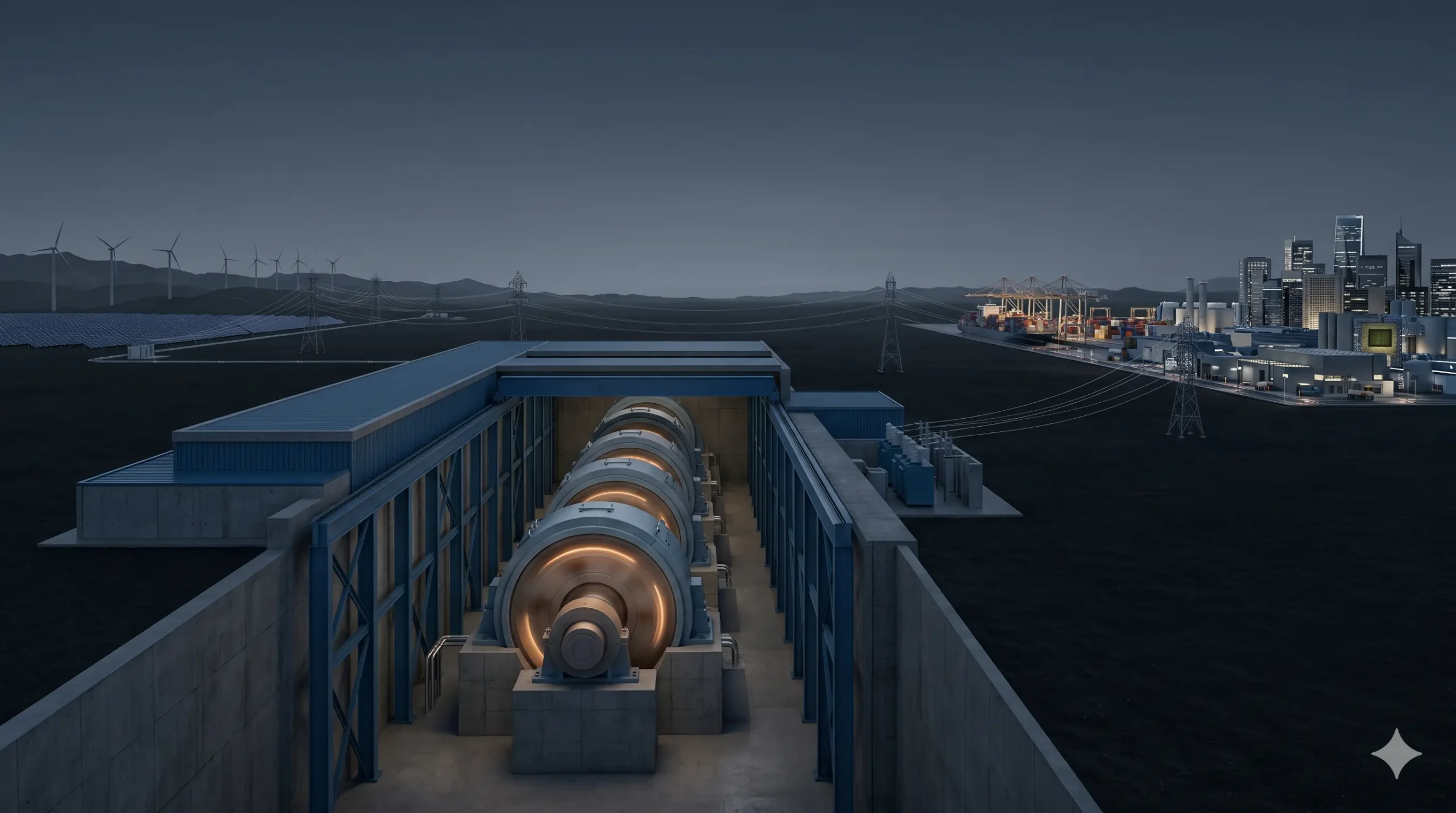
A synchronous condenser is essentially a massive electric motor that drives no mechanical load. It draws a tiny amount of active electricity simply to keep its internal rotor spinning in perfect sync with the grid. When a fault occurs, the spinning mass of the condenser naturally pushes its kinetic energy back into the network, arresting the frequency plunge and injecting the electromagnetic current required to trip safety relays.
WHY IT MATTERS NOW
The global transition to decarbonized energy systematically strips the transmission network of its mechanical stability. As utility companies retire heavy coal and nuclear plants, they permanently remove thousands of tons of spinning steel from the system. Replacing these plants with gigawatts of static solar panels leaves the grid dangerously vulnerable to rapid, unarrested frequency collapses.
Independent System Operators face a severe operational paradox. They frequently must curtail zero-cost wind and solar generation simply because the network lacks the physical inertia to survive a potential transmission fault. Operators must burn expensive natural gas just to keep heavy turbines spinning as mechanical grid stabilizers.
South Australia proved this vulnerability during a severe storm in 2016. Cascading voltage drops tripped wind farm inverters across the state, plunging the entire region into a total blackout because the grid lacked physical inertia. To prevent a recurrence, the Australian Energy Market Operator mandated the installation of four massive synchronous condensers, which now provide the bedrock mechanical strength required to routinely operate the state on 100 percent renewable energy.
Infrastructure manufacturers like GE Vernova and Siemens Energy now capitalize on this exact stabilization deficit. They retrofit decommissioned fossil fuel plants by decoupling the steam turbines and leaving the massive generators attached to the grid as free-spinning condensers. This engineering maneuver limits stranded asset losses for utility companies while physically securing the regional transmission network.
WHAT MOST PEOPLE MISS
Public policy heavily frames grid stability entirely as a battery storage problem. Environmental analysts assume that if a solar farm installs enough lithium-ion cells, the grid remains perfectly stable. This completely ignores the fundamental physics of alternating current.
Batteries provide active power, but they cannot inherently provide the physical, kinetic resistance required to stop a microsecond frequency plunge. Synthetic inertia generated by advanced battery inverters remains a software simulation of a mechanical reality. A massive spinning block of steel cannot be hacked, contains no software bugs, and physically cannot stop spinning instantly, guaranteeing a fail-safe baseline of electromagnetic survival.
THE TRAJECTORY
Next 12–36 Months: Grid operators will establish distinct market mechanisms to compensate utility companies explicitly for providing inertia and short-circuit strength. This will create a standalone financial revenue stream separate from actual megawatt generation.
Next Five Years: Manufacturers will deploy high-mass flywheel attachments directly coupled to synchronous condenser shafts. This physical addition will artificially multiply the moment of inertia, allowing smaller-footprint machines to secure highly unstable, isolated microgrids.
Next Ten Years: Grid-forming inverters will reach computational parity with physical mass. Supercomputers running microsecond control algorithms will simulate mechanical inertia with enough precision and reliability to begin phasing out the requirement for spinning steel.
What Could Go Wrong: Miscalculating the minimum required inertia floor of a regional transmission network sets the stage for disaster. If the system drops below a critical frequency threshold before the condensers can physically react, automated relays will instantly sever the grid into dark islands to protect the physical wires.
Most Likely Outcome: Synchronous condensers will serve as the mandatory, heavily subsidized mechanical bridge for the next two decades. They will physically hold the alternating current grid together while the transition to fully synthetic, software-based inertia matures.
KEY TERMS
- Synchronous Condenser: A freely spinning synchronous machine connected to the electrical grid to generate or absorb reactive power and provide kinetic inertia.
- Grid Inertia: The physical kinetic energy stored in the rotating mass of large generators that opposes sudden changes in alternating current frequency.
- Short Circuit Ratio (SCR): A mathematical metric comparing the strength of the AC grid against the power rating of connected inverter-based resources, determining system stability during electrical faults.
- Reactive Power: The portion of alternating current electricity that establishes and sustains the electric and magnetic fields required by AC equipment, measured in volt-amperes reactive (VAR).
- Rate of Change of Frequency (RoCoF): The speed at which grid frequency deviates from its baseline following a sudden mismatch between power generation and demand.
SOURCES
- North American Electric Reliability Corporation (NERC) — Inverter-Based Resource Performance and Grid Inertia Requirements
- Australian Energy Market Operator (AEMO) — South Australia Synchronous Condenser Deployment and System Strength
- IEEE Power and Energy Technology Systems Journal — Synchronous Condensers for High-Inverter Penetration Grids
- Siemens Energy — Grid Stabilization and Rotating Synchronous Mass Configurations