Advertisement
)

AT A GLANCE
- Concept: Solution Mining: High-pressure fresh water dissolves subterranean salt formations to carve massive cylindrical voids.
- Concept: Fluid Displacement: Heavy brine pushes lighter crude oil up to the surface during emergency drawdowns.
- Concept: Salt Creep: Extreme underground geological pressure slowly squeezes the cavern walls inward over time.
- Concept: Structural Fatigue: Repeated fresh water injections dissolve structural walls, permanently limiting cavern refill cycles.
HOW IT WORKS
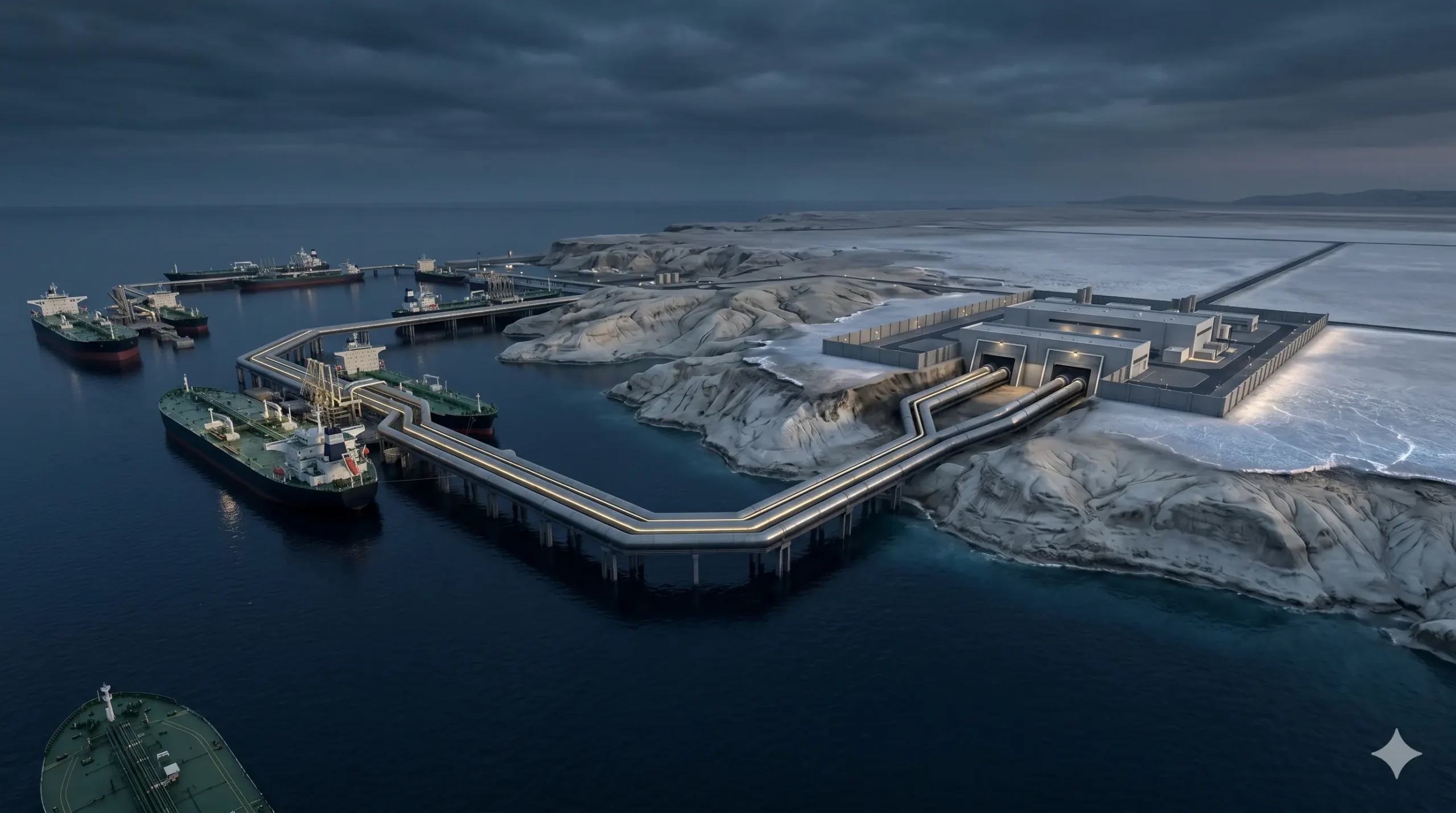
Deep underground along the Gulf Coast sit massive geological salt domes. Rock salt possesses a unique crystalline structure that remains naturally self-healing and completely impermeable to liquid hydrocarbons. This geological reality makes subterranean salt domes the perfect physical containment vessels for sovereign crude oil reserves.
To create a storage void, engineers execute a process called solution mining. They drill a primary well deep into the salt dome and inject high-pressure fresh water down the steel casing. The fresh water rapidly dissolves the surrounding rock salt, creating a heavy brine that gets continuously pumped back to the surface.
This continuous chemical leaching carves a massive, skyscraper-sized cylindrical cavern out of the solid rock.
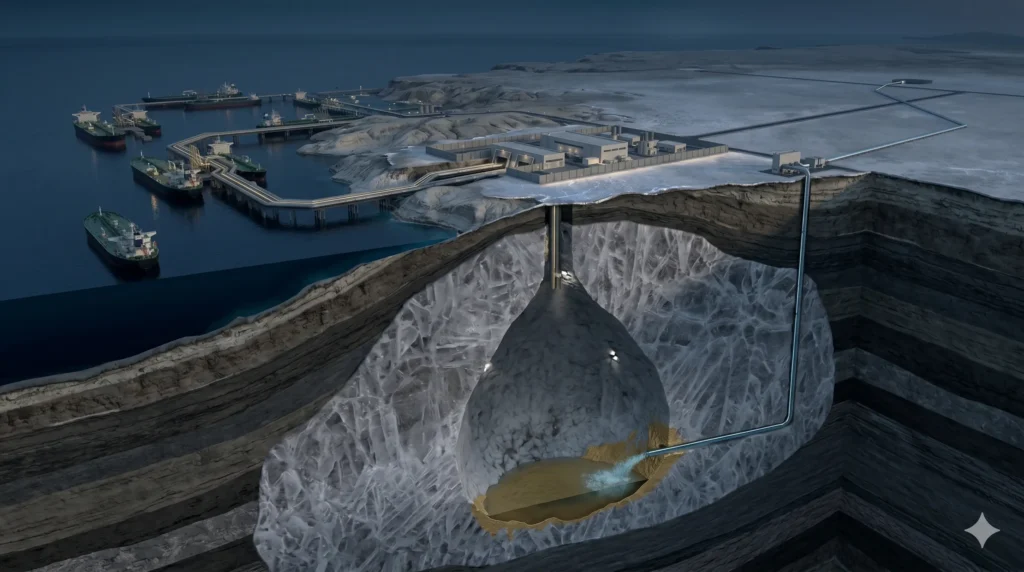
Extracting the stored oil requires a precise fluid dynamic mechanism known as displacement. Operators cannot simply lower a mechanical pump into the cavern to pull the oil out. Instead, they pump heavy brine directly into the bottom of the cavern.
Because crude oil is significantly lighter than saturated salt water, the oil floats perfectly on top of the brine layer. As the brine fills the bottom of the cavern, it physically pushes the crude oil up the extraction pipe and into surface pipeline networks.
To refill the cavern, the entire fluid cycle reverses. Operators pump raw crude oil into the top of the cavern, forcing the heavy brine out through the bottom extraction pipe. This fluid displacement architecture requires zero moving parts underground, minimizing the risk of mechanical failure during a national emergency.
WHY IT MATTERS NOW
Global energy security dictates the survival of modern industrial economies. When geopolitical conflicts, targeted embargoes, or extreme weather events sever international shipping lanes, nations rely immediately on their strategic reserves. These hidden stockpiles keep domestic refineries operating and military logistics networks fully fueled.
The United States Department of Energy manages the largest emergency crude oil supply in the world. Drawing down this reserve acts as a macroeconomic shock absorber, injecting millions of barrels into the open market to suppress spiking domestic energy prices. This capability provides the executive branch with a direct physical mechanism to counter global supply shocks.
Recent historic drawdowns have depleted the strategic reserve to its lowest volumetric levels in decades. Rebuilding this sovereign energy buffer is not merely a financial transaction on a government ledger. It is a severe physical logistics challenge constrained entirely by the structural limits of the aging underground caverns.
This mechanical reality directly dictates global oil market strategies. If a nation cannot quickly inject new oil due to cavern maintenance or structural fatigue, it physically cannot restock its emergency supply. This logistical delay signals vulnerability to oil-producing cartels, altering the balance of geopolitical leverage.
WHAT MOST PEOPLE MISS
Political analysts treat strategic reserves like massive steel bank vaults that can be emptied and refilled infinitely on command. They completely miss the complex geomechanical degradation that damages the containment architecture during every single drawdown cycle.
Subterranean salt is not a rigid, static rock. Under immense geological pressure and high geothermal temperatures, salt behaves like a highly viscous fluid. A thermomechanical phenomenon known as salt creep causes the cavern walls to slowly squeeze inward over time, permanently shrinking the available storage volume.
The rate of this structural closure follows a steady-state creep power law:
$$\dot{\epsilon} = A \sigma^n \exp\left(-\frac{Q}{RT}\right)$$
Where ε̇ is the strain rate, σ is the differential stress, Q is the activation energy, R is the universal gas constant, and T is the absolute temperature. This mathematical reality means the cavern is constantly trying to crush itself closed.
Furthermore, if operators use fresh water instead of saturated brine to push the oil out during an emergency, the fresh water dissolves the cavern walls further. This uncontrolled chemical leaching expands the void unpredictably, thinning the supporting pillars between adjacent caverns and establishing a hard mathematical limit on how many times a reserve can be cycled before catastrophic mechanical failure.
THE TRAJECTORY
Next 12–36 Months: Operators will heavily rely on saturated brine rather than fresh water for drawdowns to prevent further cavern wall leaching. This operational shift will naturally slow maximum extraction rates to protect long-term structural integrity.
Next Five Years: Advanced 3D sonar mapping will dictate mandatory cavern retirement schedules. Geologists will abandon structurally compromised caverns and initiate multi-year solution mining projects to carve replacement voids, shifting massive capital back into subterranean infrastructure.
Next Ten Years: Sovereign states will diversify emergency energy storage beyond centralized crude oil caverns. Distributed arrays storing refined products and alternative fuels in hard-rock mined facilities will reduce the single-point failure risk of regional salt domes.
What Could Go Wrong: Excessive salt creep or uncontrolled fresh water over-leaching could cause a cavern roof to breach. A catastrophic subterranean collapse would permanently trap tens of millions of barrels of oil underground, instantly erasing a fraction of the nation’s strategic energy defense.
Most Likely Outcome: The maximum safe capacity of legacy salt caverns will permanently degrade. Nations will operate their reserves at lower target volumes, accepting a higher baseline vulnerability to international supply shocks to extend the physical lifespan of the existing infrastructure.
KEY TERMS
- Solution Mining: The process of injecting water into underground soluble deposits to dissolve the mineral and extract it as a brine.
- Salt Creep: The slow, plastic deformation of subterranean rock salt under immense geological pressure that gradually shrinks underground voids.
- Fluid Displacement: A mechanical extraction method where a heavier liquid is pumped into a vessel to push a lighter liquid to the surface.
- Cavern Convergence: The physical reduction in storage volume inside a salt dome caused by the inward movement of the surrounding rock.
- Strategic Petroleum Reserve (SPR): A government-controlled stockpile of crude oil maintained to mitigate economic disruptions during severe supply chain crises.
SOURCES
- Department of Energy (DOE) — Strategic Petroleum Reserve Geomechanical Integrity Assessment
- Sandia National Laboratories — Geomechanics of Salt Caverns for Strategic Petroleum Storage
- Journal of Petroleum Science and Engineering — Analysis of Salt Creep and Cavern Convergence Rates
- International Journal of Rock Mechanics and Mining Sciences — Structural Stability of Leached Salt Caverns During Drawdown Cycles