
AT A GLANCE
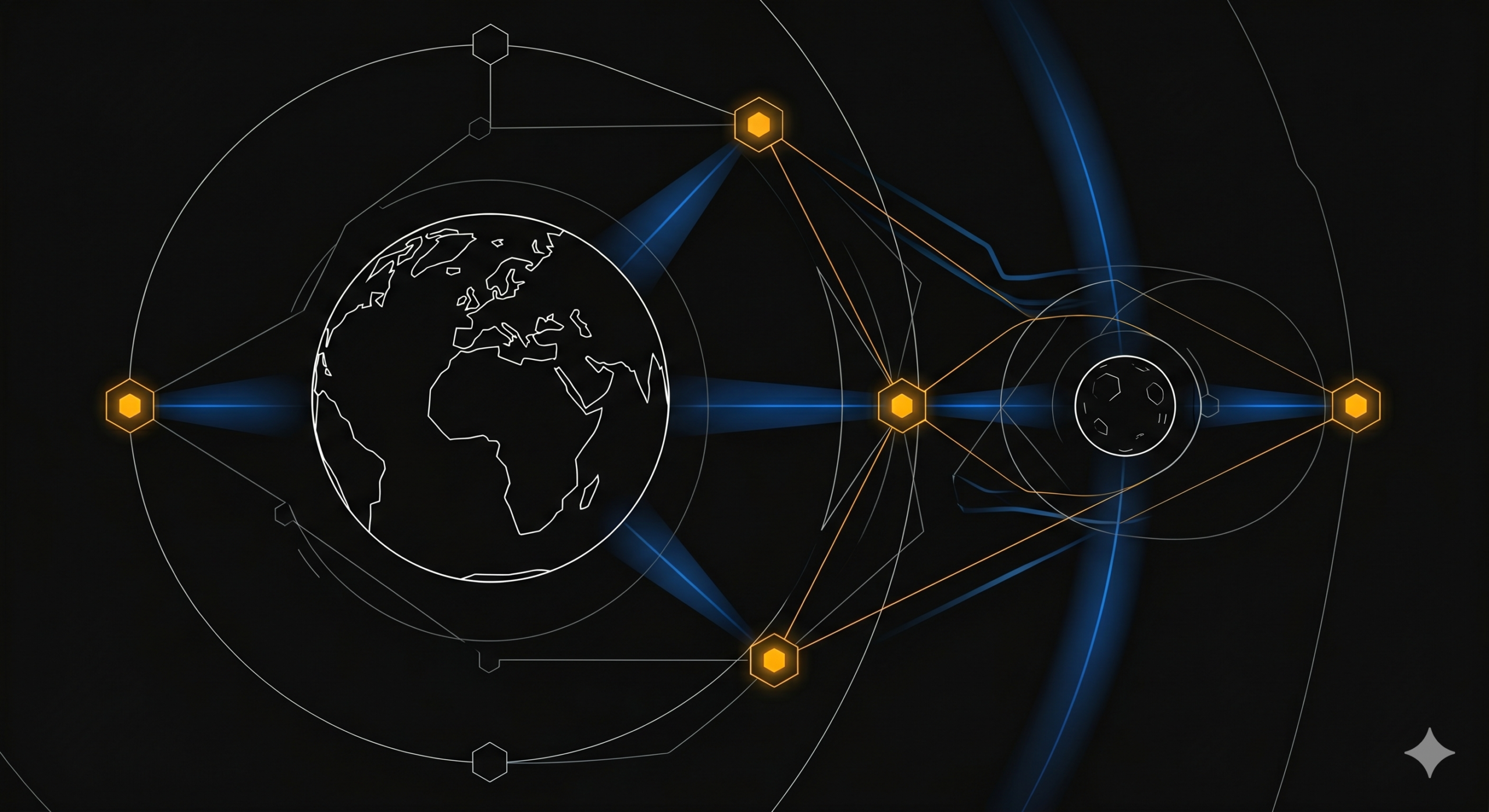
- Zero-Gravity Parking: Spacecraft stationed at Earth-Moon Lagrange points require near-zero fuel to maintain orbit.
- The Delta-V Advantage: Launching a payload from a Lagrange point to deep space costs significantly less fuel than launching directly from low Earth orbit (LEO).
- Strategic Chokepoints: Whoever controls the L1 and L2 halo orbits physically dictates the supply chain for lunar surface operations.
- De Facto Annexation: The Artemis Accords establish “safety zones” that bypass the 1967 Outer Space Treaty, creating functional private property in orbit.
HOW IT WORKS (The Mechanism)
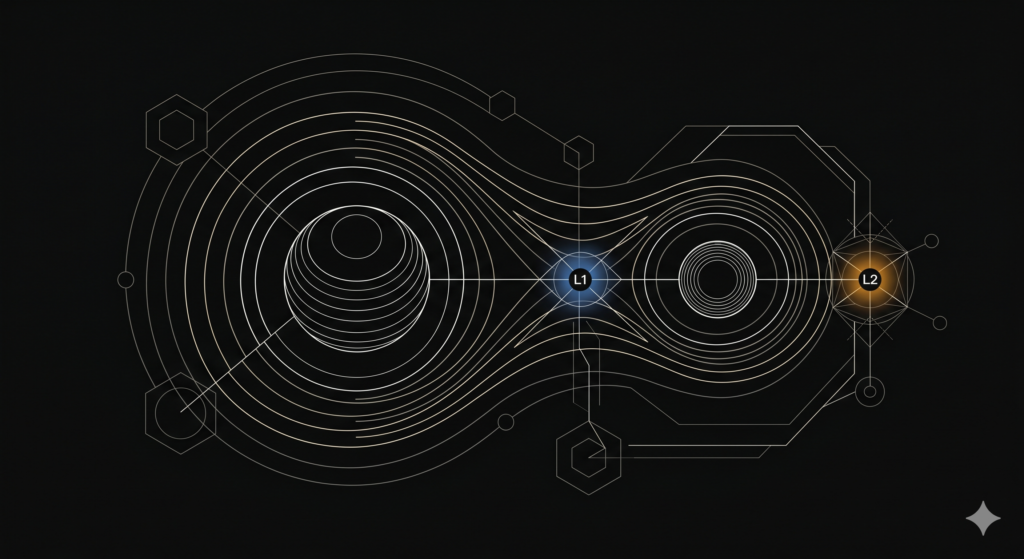
Gravity pulls things down. The Earth pulls hard. The Moon pulls slightly less. Between them, physics creates five specific dead zones. We call them Lagrange points. In these zones, the gravitational pull of the Earth and the Moon perfectly cancel out the centrifugal force of a spacecraft.
Think of it like balancing a marble on top of a smooth hill. It stays there with almost zero effort.
Engineers use a metric called Delta-v. It measures the physical energy required to move a ship. Escaping Earth’s gravity requires massive Delta-v. Moving from Earth-Moon L1 to anywhere else in the solar system requires almost none. You build the ship on Earth. You park it at L1. You load it with lunar-mined fuel. You launch it to Mars for a fraction of the structural cost.
WHY IT MATTERS NOW (The Human Impact)
Space is no longer a science experiment. It is a raw logistics problem. Commercial aerospace companies and national defense agencies face brutal payload economics. Lifting a single kilogram of water to the Moon costs thousands of dollars. The nation that secures the L1 and L2 halo orbits controls the ultimate cosmic staging ground. They dictate the toll roads for lunar mining, satellite repair, and deep-space military deployment. If a competitor builds an industrial refueling depot at Earth-Moon L2, they own the logistical monopoly for the next century of space expansion.
WHAT MOST PEOPLE MISS
The public thinks space is infinite. Cis-lunar orbital slots are strictly finite. You cannot put a thousand space stations in a Near Rectilinear Halo Orbit (NRHO). The physics do not allow it. Objects will collide. The geopolitical tension does not involve claiming the physical dirt on the Moon. It involves claiming the invisible gravitational highways leading to it. The United States pushes the Artemis Accords to establish operational “safety zones.” China and Russia counter with the International Lunar Research Station (ILRS) framework. They fight a cold war over empty space. The first mover claims the orbit permanently.
THE TRAJECTORY (What Happens Next)
Over the next 12 to 36 months, the United States will deploy the first modules of the Lunar Gateway into NRHO. China will simultaneously accelerate its Queqiao relay satellite network at L2, aggressively locking down the primary communication bandwidth for the lunar far side.
KEY TERMS
- Lagrange Point: A location in space where the combined gravitational forces of two large bodies equal the centrifugal force felt by a smaller third body.
- Delta-v: A measure of the impulse required to perform a maneuver, determining exactly how much fuel a spacecraft needs to change trajectories.
- Near Rectilinear Halo Orbit (NRHO): A highly elliptical orbit around a Lagrange point that provides stable, long-term staging with minimal station-keeping fuel.
- Cis-lunar Space: The spherical volume of space extending from Earth’s atmosphere out to and just beyond the Moon’s orbit.
- Artemis Accords: A US-led multilateral agreement establishing behavioral norms and de facto exclusionary safety zones for space resource extraction.
SOURCES
- NASA Technical Reports Server – “Gateway Formation Flying and Station-Keeping in NRHO” (2024).
- Center for Strategic and International Space (CSIS) – “Cislunar Security and the Artemis Accords” (2025).
- European Space Agency (ESA) – “Economics of Lagrange Point Logistics” (2025).
- Journal of Spacecraft and Rockets – “Delta-v Budgets for Earth-Moon and Deep Space Transfers” (2024).
RELATED TOPICS
- Read Next: The Dark Fleet Matrix: Tokenized Commodity Routing and AIS Spoofing
- Read Next: The Memristor Array: Bypassing the Von Neumann Bottleneck
- Read Next: The CRISPR Off-Target Dynamics: The Unmapped Chaos of Cellular Repair
- Read Next: The Predatory Speed of Light: Latency Arbitrage in Market Microstructure