Advertisement
)

AT A GLANCE
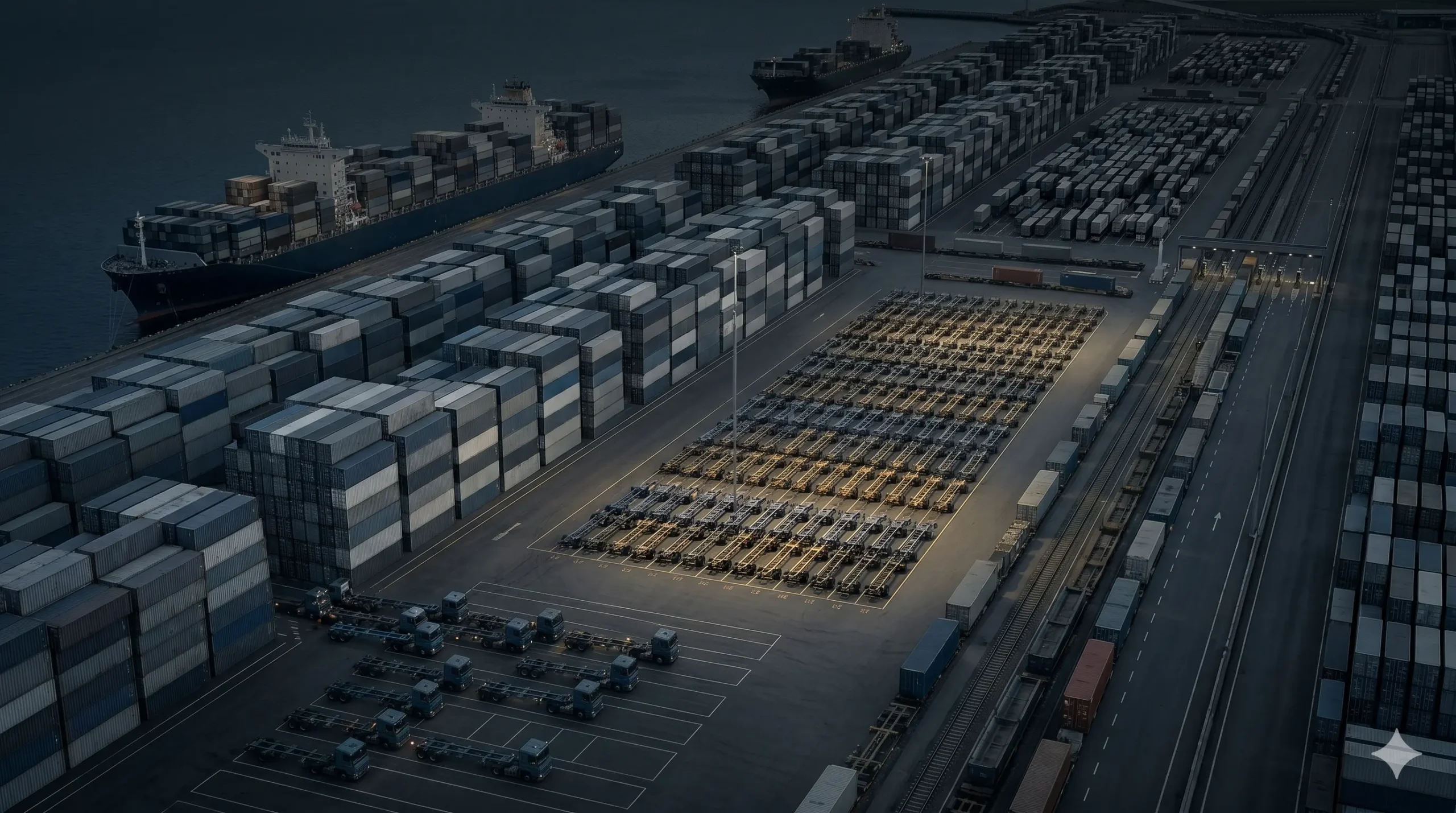
- Concept: Wheel and Frame: Containers remain completely immobile on port asphalt without a matching steel chassis.
- Concept: Fleet Pooling: Shared equipment pools consolidate disparate chassis to reduce individual carrier capital expenditures.
- Concept: Roadability Protocols: Strict safety inspections frequently sideline entire transport fleets, halting cargo movement instantly.
- Concept: Yard Gridlock: A mismatch in chassis positioning creates severe, cascading bottlenecks at terminal gates.
HOW IT WORKS
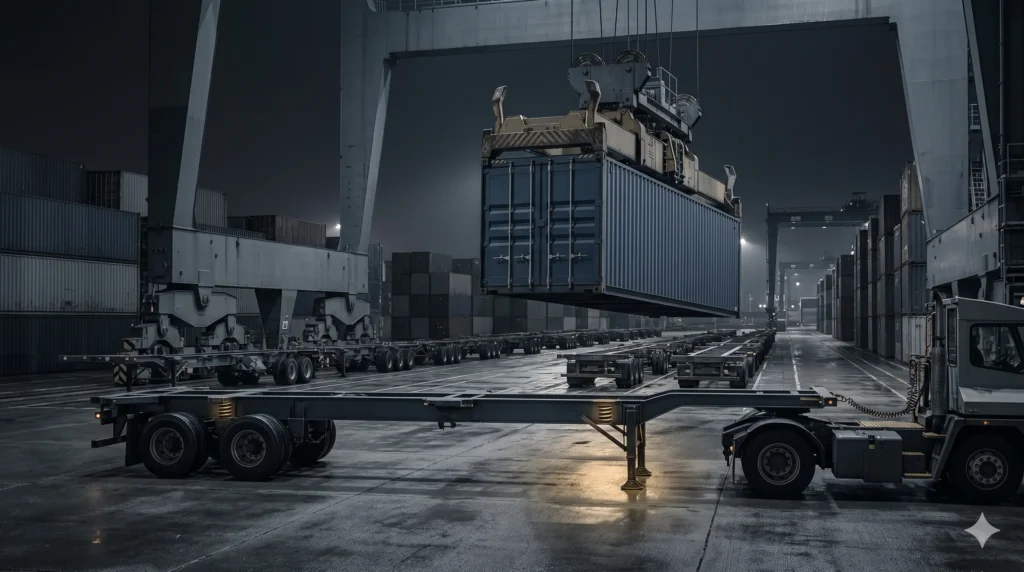
Global shipping relies entirely on the standardized twenty-foot and forty-foot ISO container. While container ships carry these steel boxes across oceans and gantry cranes lift them onto land, the boxes cannot move a single inch on public roads without a specialized wheeled steel frame. This frame is the intermodal chassis.
The physical chassis locks the container in place using standard corner castings and manual twist-locks. This structural marriage transforms a static metal crate into a street-legal semi-trailer capable of highway speeds.
Standard logistics networks manage these assets through physical equipment pools. Instead of every trucking company owning unique trailers, neutral pool operators maintain centralized fleets at rail yards and marine terminals.
Motor carriers rent these trailers on a per-diem basis, retrieve container loads, and return them once the container reaches its inland destination. Highly optimized fleet allocation algorithms predict local container arrival rates to balance the physical distribution of these trailers across regional transport hubs.
The physics of weight distribution dictate chassis design. The Fourth Power Law of road damage dictates this physical distribution:
Where $D$ is the relative pavement damage, $W$ is the actual axle load, and $W_{\text{std}}$ is the standard legal axle load limit. This mathematical reality forces states to enforce strict, unyielding weight limits on every chassis frame entering public highways.
WHY IT MATTERS NOW
Global supply chain stability currently hinges on the physical speed of inland evacuation. Marine terminals cannot stack incoming shipping containers indefinitely. When a terminal runs out of physical asphalt space, ships must idle at anchor, immediately triggering global supply shortages.
The available supply of roadable chassis ultimately dictates terminal clearance speed. During periods of high imports, terminals face severe chassis deficits. Truck drivers arrive to haul containers but find no available trailers, stranding millions of dollars in cargo.
This asset shortage directly inflates global inflation. Under Federal Maritime Commission regulations, marine terminals charge shippers punitive storage fees, known as demurrage, for failing to clear containers on time.
Shippers pay these mounting fees simply because they cannot find a physical chassis to retrieve their goods. In the Port of Los Angeles, these systemic equipment delays routinely add thousands of dollars in unnecessary transactional friction to every import container.
Decarbonization goals also depend on chassis availability. When idling trucks wait outside port gates for hours waiting for a chassis to be located, they generate thousands of tons of avoidable diesel emissions.
WHAT MOST PEOPLE MISS
Mainstream economic analysts routinely blame long port delays on labor disputes, railway strikes, or driver shortages. They ignore the silent, structural drag of Federal Motor Carrier Safety Administration roadability inspection protocols.
Up to thirty percent of a port’s chassis fleet is sidelined daily due to maintenance defects like worn brake drums, flat tires, or faulty lights. Decades of underinvestment and split maintenance incentives between ocean carriers and domestic truckers ensure that these essential steel frames remain a single point of failure.
This creates a structural mismatch where the entity renting the chassis has no control over its long-term mechanical upkeep. Consequently, the physical chassis is driven until failure, creating massive system-wide equipment deficits when a major shipment arrives.
THE TRAJECTORY
Next 12–36 Months: Port authorities will mandate telematics tracking across all pool fleets. Integrated GPS sensors and digital load-detectors will feed real-time usage data to predictive yard management software, reducing empty repositioning miles.
Next Five Years: High-precision computer-vision gantries will automate the physical roadability inspection process at terminal gates. Automated laser scanners will diagnose structural wear, brake thickness, and tire pressure in seconds, eliminating manual inspection bottlenecks.
Next Ten Years: Self-driving class 8 trucks will operate in dedicated industrial corridors, directly matching with automated, sensor-enabled chassis arrays. This integration will create a continuous, twenty-four-hour loop of container evacuation running independent of human labor shifts.
What Could Go Wrong: Escalating trade disputes or component steel tariffs could halt the domestic manufacture of new chassis frames. Because the United States restricts the import of low-cost Chinese chassis under anti-dumping duties, any domestic factory delay will cause long-term equipment shortages.
Most Likely Outcome: Chassis pooling models will consolidate into a few highly regulated, utility-like regional monopolies. These dominant networks will prioritize asset tracking and preventative maintenance to protect their margins under increasing regulatory oversight from the Federal Maritime Commission.
KEY TERMS
- Intermodal Chassis: A specialized steel wheeled frame engineered to transport standard ISO shipping containers over roads.
- Chassis Pool: A consolidated fleet of intermodal trailers shared among multiple trucking companies to improve regional asset utilization.
- Roadability: The legal safety status of a commercial trailer as defined by federal highway transportation regulations.
- Container Turn Time: The total duration required for a truck to enter a terminal, exchange a container, and depart.
- Demurrage: Punitive storage fees charged by marine terminals when a shipper fails to retrieve their container within allocated free time.
SOURCES
- Federal Maritime Commission — Report on Intermodal Chassis Availability and Pooling
- American Trucking Associations — Intermodal Motor Carriers Conference Roadability Analysis
- Journal of Commerce — Global Port Congestion and Equipment Constraints
- Federal Motor Carrier Safety Administration — Intermodal Equipment Provider Regulations