
AT A GLANCE
- Concept: Lasers require nanoradian mechanical accuracy to hit moving targets across thousands of miles.
- Concept: Spacecraft traveling at high speeds generate extreme optical Doppler shifts.
- Concept: Internal satellite vibrations act as the primary enemy of stable laser connections.
- Concept: Militaries use crosslinks to build closed-loop internets immune to terrestrial tapping.
HOW IT WORKS (THE MECHANISM)
Spacecraft in low Earth orbit travel at roughly seventeen thousand miles per hour. They continuously change their relative positions.
To send data, one satellite fires a near-infrared laser at another. The beam is incredibly narrow. At a distance of a thousand kilometers, the receiving telescope measures only a few inches across.
Hitting this target requires an extreme pointing error budget. Engineers measure this necessary accuracy in nanoradians. A single nanoradian equals one-billionth of a degree.
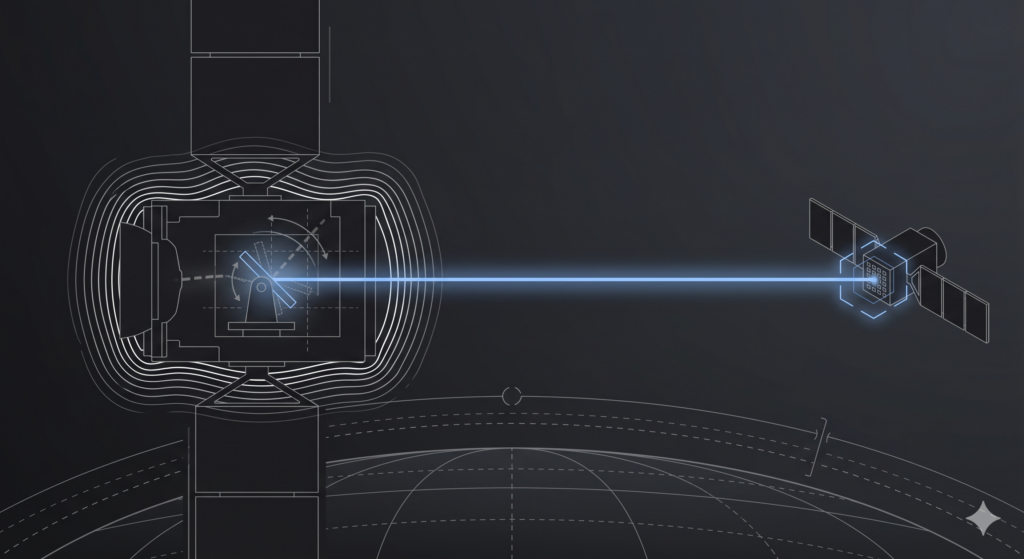
The connection relies on a Pointing, Acquisition, and Tracking mechanism. A coarse pointing gimbal turns the entire optical terminal toward the target. Then, a fast steering mirror takes over to make microscopic, high-frequency adjustments.
These mirrors bounce the beam to counteract the physical vibrations of the satellite itself. This stabilizes the laser long enough to encode gigabits of data through phase-shift keying.
WHY IT MATTERS NOW (THE HUMAN IMPACT)
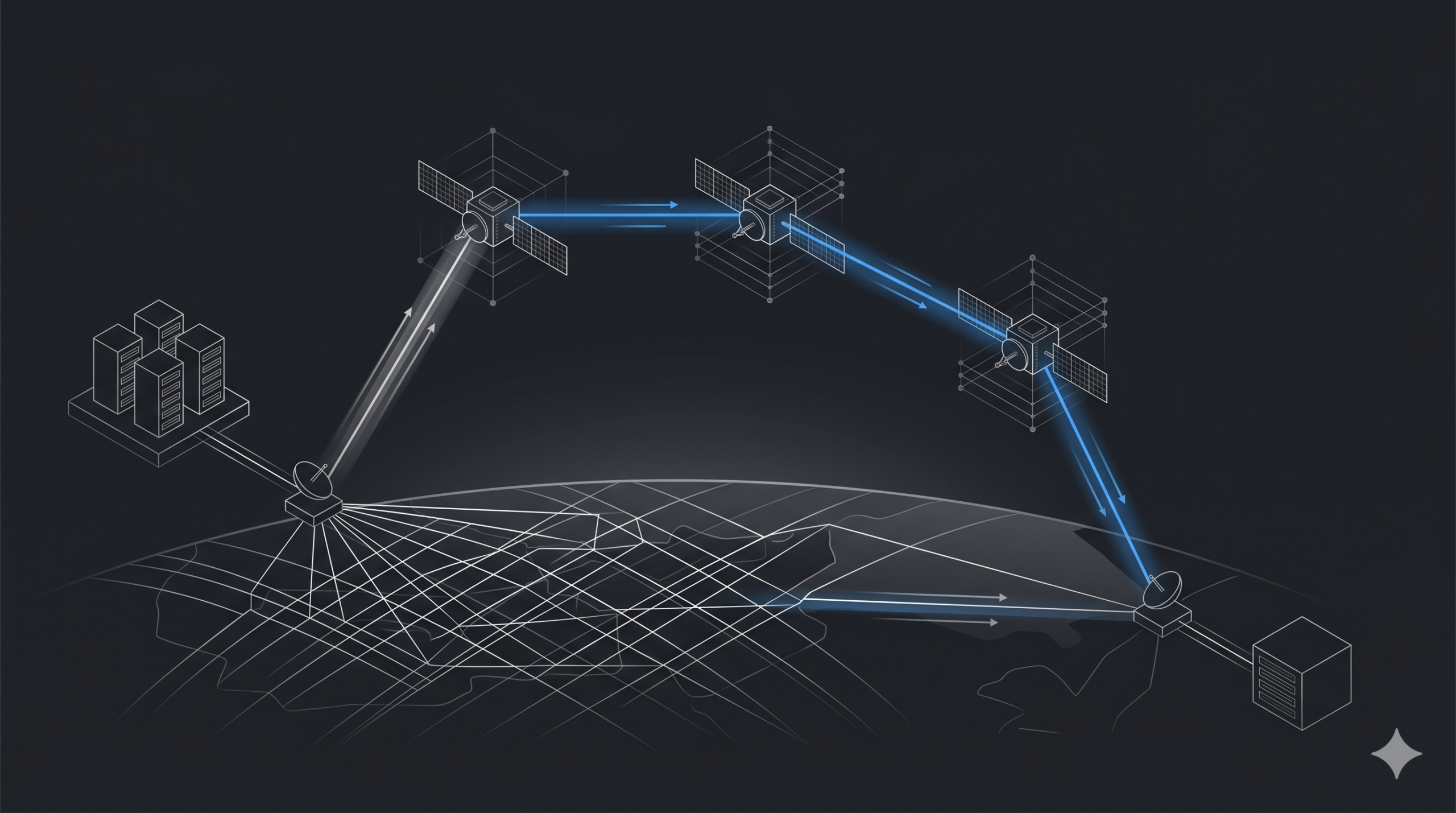
Traditional space communication acts like a simple relay. A satellite collects data and waits until it flies over a friendly ground station to beam it down.
This physical delay breaks modern military kill chains. If a sensor over the Pacific detects a hypersonic launch, it cannot wait thirty minutes to find a downlink station.
Optical inter-satellite links fix this delay. They bounce the warning signal horizontally across a web of satellites. The data travels through the vacuum of space at the absolute speed of light.
The United States Space Force currently deploys the Proliferated Warfighter Space Architecture. This mesh network relies entirely on laser crosslinks to function.
It routes targeting data from tracking satellites directly to naval destroyers. The data never touches a vulnerable undersea cable. It creates an unjammable, sovereign intranet operating completely above the atmosphere.
WHAT MOST PEOPLE MISS
Public discourse assumes laser communication fails due to clouds or atmospheric distortion. This applies only to space-to-ground links. In the vacuum of orbit, the primary threat is internal mechanics.
The hidden mechanism destroying orbital crosslinks is micro-jitter. A satellite keeps its solar panels pointed at the sun using internal spinning reaction wheels. These heavy wheels vibrate.
This microscopic humming travels through the spacecraft chassis into the optical telescope. If the fast steering mirror cannot perfectly negate this specific vibration frequency, the laser misses the target entirely. The connection drops.
THE TRAJECTORY (12–36 MONTHS)
Over the next thirty-six months, defense agencies will mandate strict optical interoperability standards. Currently, a laser terminal built by one defense contractor cannot easily talk to a terminal built by another.
The Space Development Agency will strictly enforce universal optical waveforms. This regulatory pressure forces hardware vendors to abandon proprietary protocols.
Satellites from different commercial mega-constellations will soon route data through each other. This creates an optical backbone resilient enough to survive kinetic anti-satellite attacks. If an adversary destroys one node, the lasers simply and instantly recalculate a new path around the debris.
KEY TERMS
- Pointing Error Budget: The mathematical allocation of allowable mechanical inaccuracies within an optical system before the laser misses its target.
- Nanoradian: An extremely small unit of angular measurement used to quantify the precision of laser pointing systems.
- Micro-Jitter: High-frequency, low-amplitude mechanical vibrations generated by internal spacecraft components like reaction wheels.
- Fast Steering Mirror: A highly responsive optical component that makes micro-adjustments to a laser beam’s path to compensate for physical vibration.
- Optical Waveform: The specific physical and mathematical properties of a light beam used to encode and decode transmitted data.
SOURCES
- Space Development Agency — Optical Communications Terminal Standard
- Massachusetts Institute of Technology — Pointing, Acquisition, and Tracking for Optical Space Communications
- IEEE Communications Surveys & Tutorials — Inter-Satellite Laser Communications: Current State and Future Trends
- National Aeronautics and Space Administration — Deep Space Optical Communications Engineering Constraints