
AT A GLANCE
- Concept: Eliminating grain boundaries prevents structural failure under extreme centrifugal force and heat.
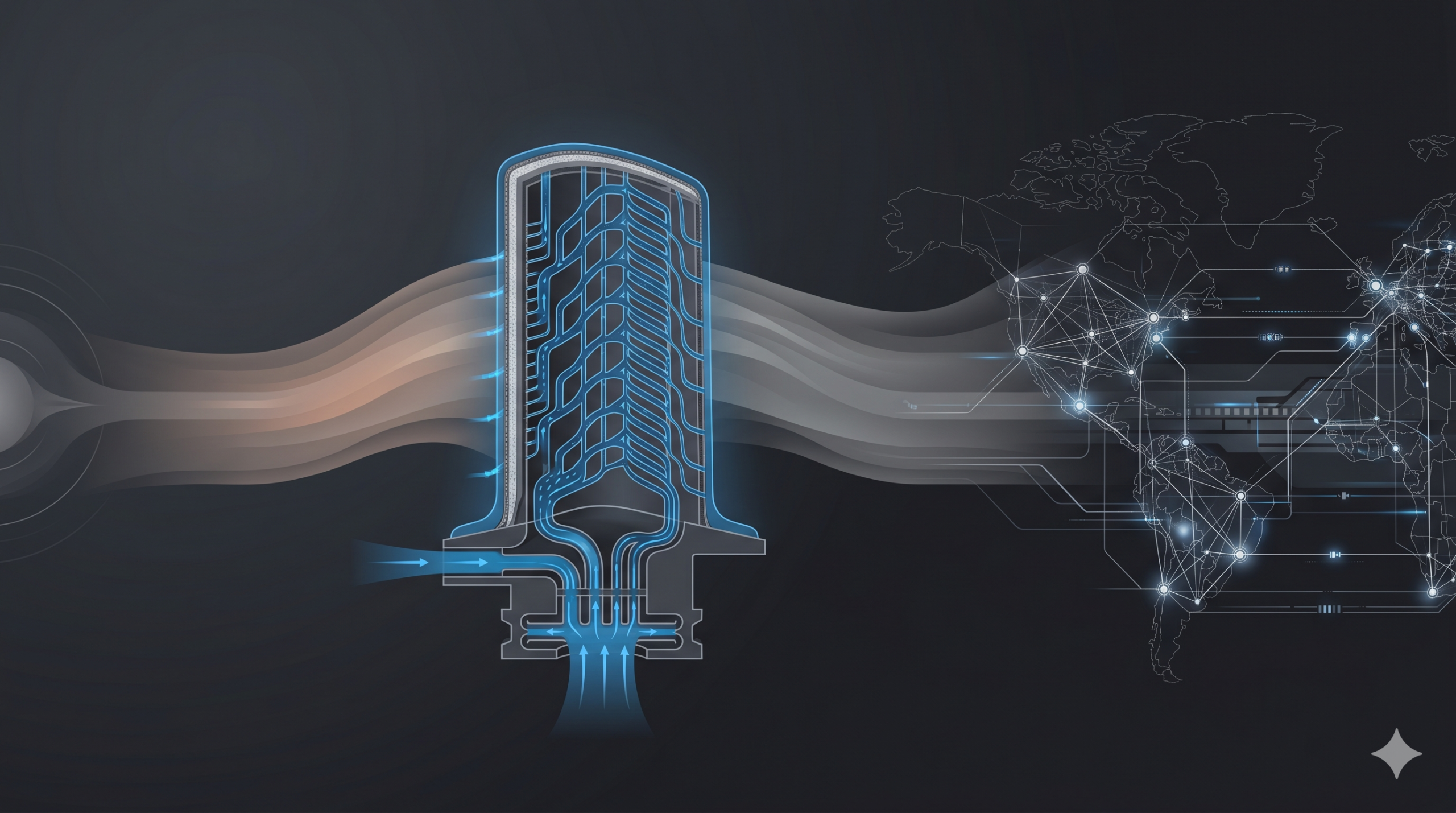
- Concept: Internal cooling channels pump compressed air to form a protective thermal film.
- Concept: Ceramic thermal barrier coatings insulate the metal from direct combustion gas.
- Concept: Three global conglomerates control the manufacturing capacity for these critical components.
HOW IT WORKS (THE MECHANISM)
Standard metals consist of millions of microscopic grains mashed together. When heated and spun at high speeds, the boundaries between these grains slip. Engineers call this mechanical deformation creep.
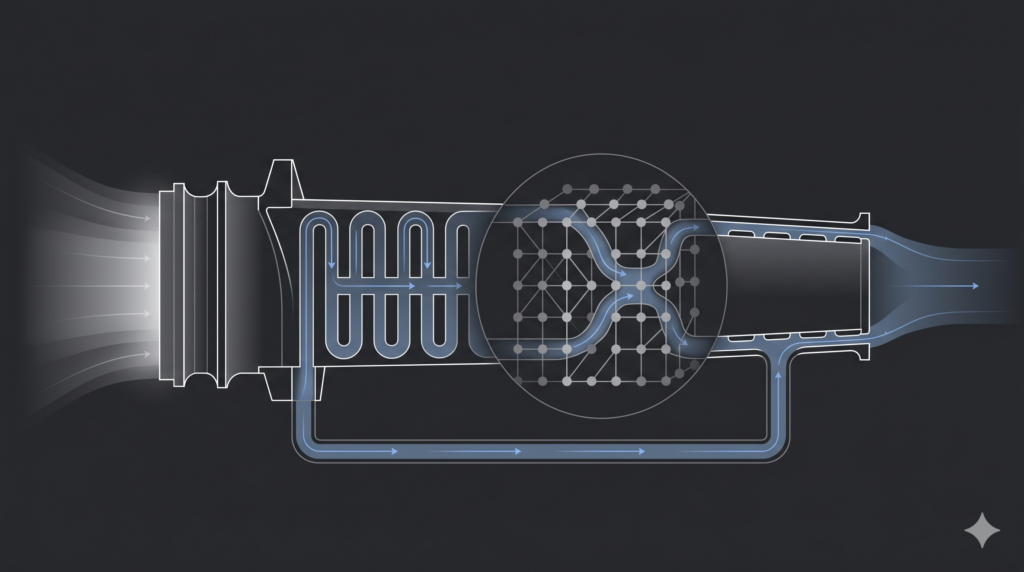
To stop creep, metallurgists eliminate the boundaries entirely. They cast the turbine blade as one continuous nickel-based crystal. The atomic lattice aligns perfectly from base to tip.
These blades sit inside the combustion zone of a heavy-duty gas turbine. The surrounding gas reaches temperatures exceeding 1,600 degrees Celsius. This physically exceeds the melting point of the nickel superalloy.
The blade survives through fluid dynamics and ceramic insulation. Engineers coat the exterior in a thermal barrier of yttria-stabilized zirconia.
Simultaneously, the system pumps high-pressure air through hollow, serpentine passages cast directly inside the crystal. This cold air bleeds out of microscopic holes drilled into the blade’s leading edge.
It forms a thin film of cool air across the metal surface. This physical barrier prevents the combustion gas from ever touching the blade.
WHY IT MATTERS NOW (THE HUMAN IMPACT)
Heavy-duty gas turbines provide the absolute bedrock of continental power grids. Solar and wind generation fluctuate with the weather. Gas turbines spin continuously to maintain the strict electrical frequency required to keep the grid online.
Thermodynamic efficiency dictates global natural gas consumption. The hotter a turbine runs, the more electricity it extracts from a single cubic meter of gas. The physical temperature limit of the single-crystal blade strictly caps this economic efficiency.
In 2022, the European energy crisis forced utilities to squeeze every megawatt out of existing infrastructure. Facilities running Siemens SGT5-8000H turbines relied entirely on these specific blades to maintain sixty percent combined-cycle efficiency while burning minimal fuel.
Casting these blades requires immense capital and proprietary metallurgy. The process involves pulling liquid metal through a precise thermal gradient in a vacuum furnace. Only a fraction of the castings survive quality control.
This difficulty creates a brutal industrial bottleneck. General Electric, Siemens Energy, and Mitsubishi Heavy Industries hold a functional monopoly on the heavy-duty gas turbine supply chain. Sovereign nations cannot build high-efficiency natural gas power plants without buying the crystals from these three firms.
WHAT MOST PEOPLE MISS
Most analysts assume the power grid relies simply on the volume of fuel burned. They ignore the microscopic chemical arms race happening inside the turbine.
The hidden constraint is not fuel, but structural creep limit. When a grid operator demands more power during a heatwave, they fire the turbine hotter. This consumes the microscopic creep life of the blade mathematically. The operator trades physical metal fatigue for immediate electrical output.
THE TRAJECTORY (12–36 MONTHS)
Over the next thirty-six months, global emission mandates will force these turbines to burn hydrogen blends instead of pure natural gas. Hydrogen burns significantly hotter and produces water vapor.
This vapor brutally attacks current thermal barrier coatings. The steam penetrates the ceramic layers, causing the yttria-stabilized zirconia to physically flake off the metal substrate.
Manufacturers will aggressively deploy advanced environmental barrier coatings utilizing rare-earth silicates. These new chemical armors will seal the single-crystal alloys against steam degradation, dictating the physical viability of the global hydrogen economy.
KEY TERMS
- Single-Crystal Superalloy: A highly engineered metal component cast with a continuous atomic lattice to eliminate structural weak points.
- Creep: The slow, permanent mechanical deformation of a solid material subjected to constant stress and extreme heat.
- Thermal Barrier Coating (TBC): A highly specialized ceramic layer applied to metal surfaces to insulate them from extreme combustion temperatures.
- Film Cooling: The process of pumping cold air through microscopic holes to create a protective thermal boundary layer across a surface.
- Baseload Power: The minimum amount of continuous electrical power required to supply a regional grid at any given time.
SOURCES
- ASME (American Society of Mechanical Engineers) — Advances in Single Crystal Superalloys for Gas Turbines
- Department of Energy (DOE) — Advanced Turbine Systems Program
- Mitsubishi Heavy Industries Technical Review — Development of High-Efficiency Gas Turbine Technologies
- Materials Science and Engineering: A — Creep deformation mechanisms in nickel-base single crystal superalloys