
AT A GLANCE
- The Heartbeat: The US power grid operates at exactly 60 Hertz. Deviations of just 0.5 Hertz trigger rolling blackouts.
- The Missing Mass: Solar panels and inverter-connected wind turbines provide zero physical rotational inertia.
- The Speed of Failure: Without physical mass, grid frequency collapses in milliseconds during a supply shock.
- The Phantom Machines: Grid operators now spend billions installing “synchronous condensers”—massive, unpowered motors that consume electricity just to spin in place.
HOW IT WORKS (The Mechanism)
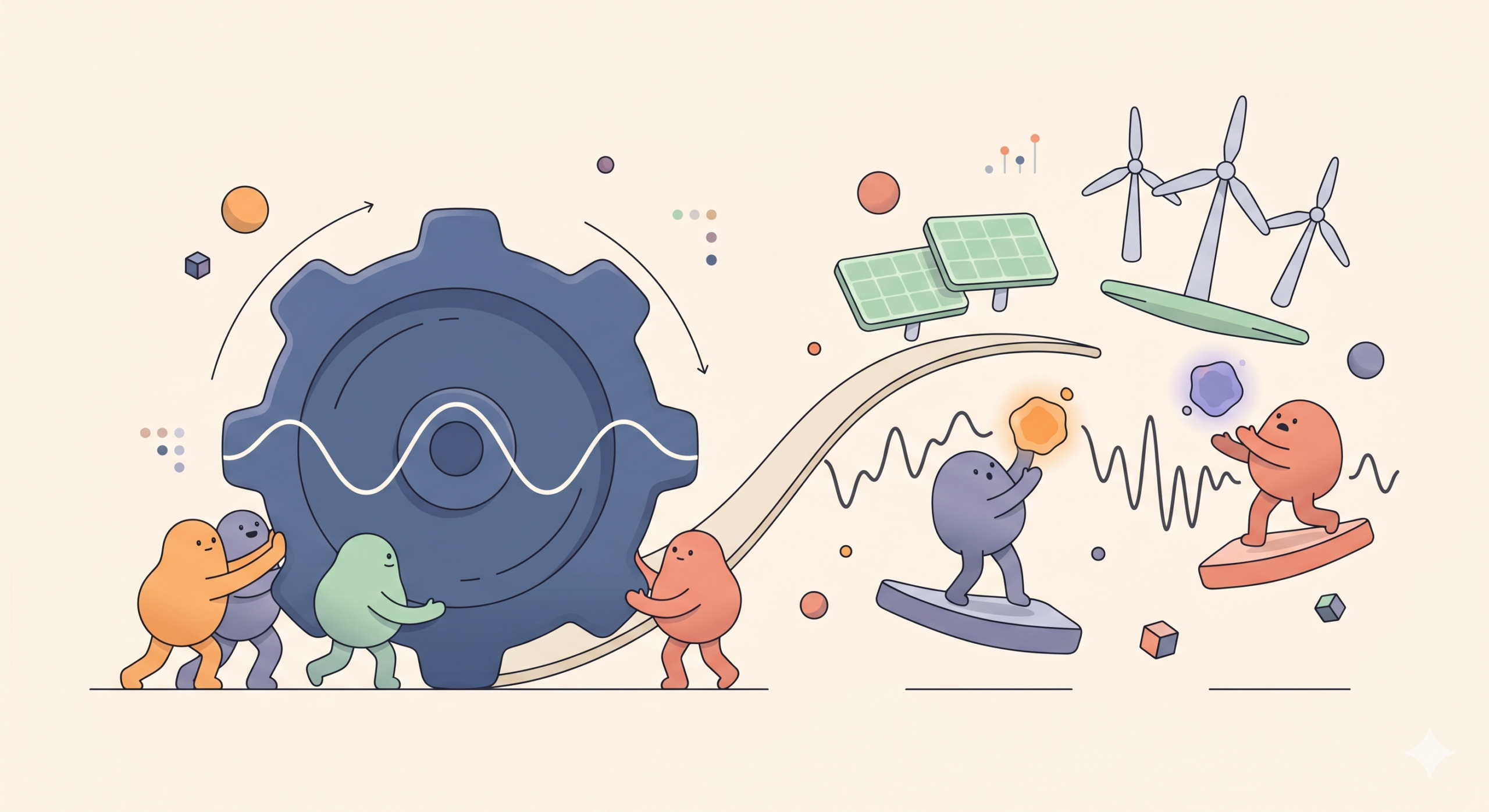
The power grid operates as a giant machine. It breathes alternating current. In North America, the heartbeat remains strictly 60 Hertz. Supply must match demand instantly. Every single second. Traditional power plants burn coal or split atoms to boil water. The expanding steam spins massive steel turbines. These turbines weigh hundreds of tons. They spin at exactly 3,600 revolutions per minute. This movement creates immense kinetic energy. Engineers call this rotational inertia.
If a generator trips offline, grid frequency drops. The steel turbines keep spinning out of pure momentum. They act as physical shock absorbers. They inject instant kinetic energy directly into the grid. This buffer buys human operators time to balance the system.
Solar panels lack moving parts. Wind turbines connect through digital inverters. These inverters strip away the mechanical momentum. When clouds block the sun, power output crashes immediately. Nothing catches the fall.
WHY IT MATTERS NOW (The Human Impact)
Kinetic energy prevents blackouts. In 2016, severe weather triggered a massive supply shock in South Australia. The state relied heavily on wind generation. The grid lacked physical inertia. Frequency collapsed in milliseconds. The entire state went dark. Aluminum smelters froze. Hospitals lost power. Infrastructure funds now recognize a hard physical limit. Building gigawatts of solar capacity means nothing if the local grid cannot absorb the load. To prevent system collapse, operators actively cap renewable output. They enforce strict inertia floors. This dynamic strands billions of dollars in green energy investments.
WHAT MOST PEOPLE MISS
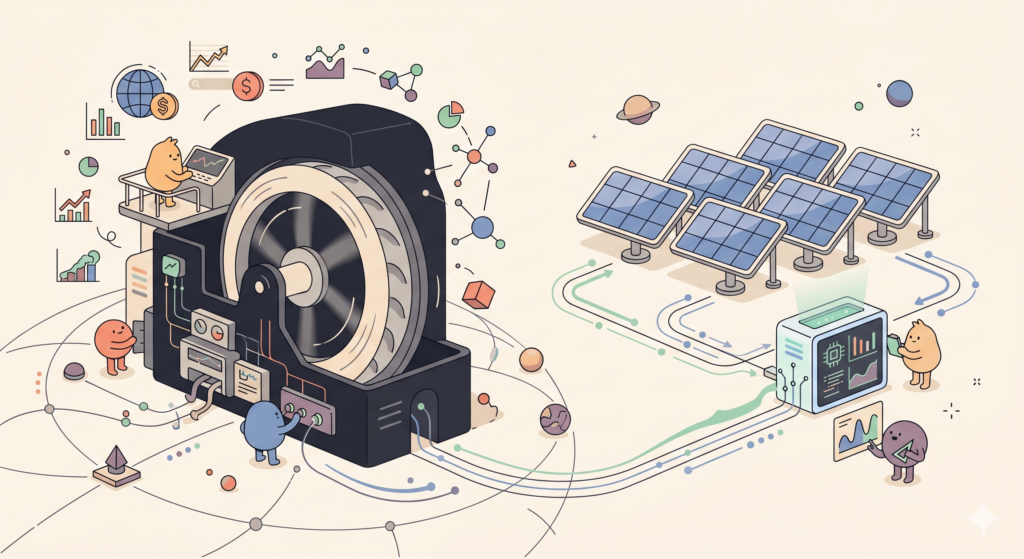
Politicians frame chemical batteries as the ultimate grid fix. They ignore fundamental physics. Lithium-ion batteries store chemical energy. They sit completely still. Even the fastest battery requires milliseconds to detect a frequency drop and inject power. A spinning steel turbine requires zero milliseconds. It resists the drop naturally. You cannot replace a physical kinetic shock absorber with a fast digital battery. Operators now spend billions buying synchronous condensers. These massive, empty motors consume electricity merely to spin heavy flywheels. They add zero new power. They only buy physical time.
THE TRAJECTORY (What Happens Next)
Over the next 36 months, global grid operators will mandate kinetic mass requirements for all new renewable interconnections. Private capital will aggressively shift from building raw solar farms toward funding synchronous condenser facilities and advanced grid-forming inverters to stabilize the increasingly fragile network.
KEY TERMS
- RoCoF (Rate of Change of Frequency): The mathematical speed at which a power grid loses its target frequency during a sudden supply shock.
- Rotational Inertia: The physical kinetic energy stored in heavy, spinning generators that naturally resists changes in grid speed.
- Synchronous Condenser: A massive, unattached motor that spins freely on the grid to provide physical stability without generating electricity.
- Grid-Forming Inverter: A software-driven power converter that attempts to synthetically mimic the physical momentum of traditional rotating machinery.
- Alternating Current (AC): An electric current that periodically reverses direction, operating at a strictly maintained global standard of 50 or 60 cycles per second.
SOURCES
- North American Electric Reliability Corporation (NERC) – “Inverter-Based Resource Performance Issues” (2025).
- Australian Energy Market Operator (AEMO) – “Renewable Integration Study: System Inertia” (2024).
- National Renewable Energy Laboratory (NREL) – “The Role of Synchronous Condensers in High-Renewable Grids” (2025).
- IEEE Power and Energy Magazine – “Frequency Control in the 100% Inverter-Based Grid” (2026).
RELATED TOPICS
- Read Next: THE FEDERAL RESERVE SWAP LINES: THE INVISIBLE PIPING OF DOLLAR HEGEMONY
- Read Next: THE MALACCA DILEMMA: MATHEMATICAL MODELING OF CHOKEPOINT COLLAPSE
- Read Next: THE ASML HIGH-NA EUV: THE KINETIC PHYSICS OF MICROCHIP HEGEMONY