Why Software Is Shifting From Tools to Workers
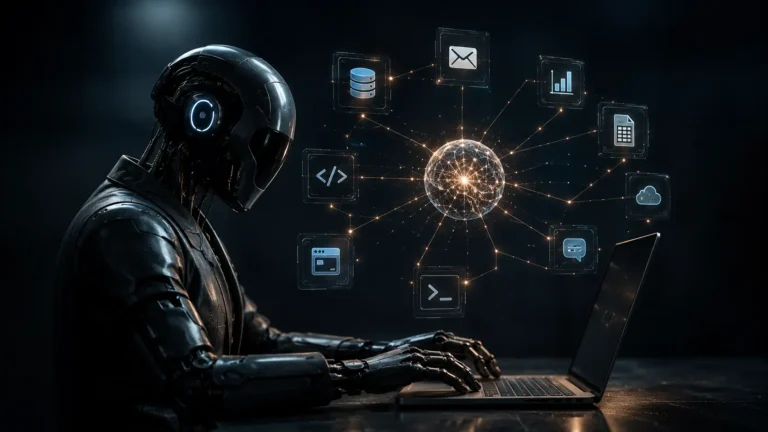
Autonomous AI agents are software programs powered by large language models that can independently plan, reason, and execute complex multi-step tasks across corporate systems without human supervision.

Autonomous AI agents are software programs powered by large language models that can independently plan, reason, and execute complex multi-step tasks across corporate systems without human supervision.

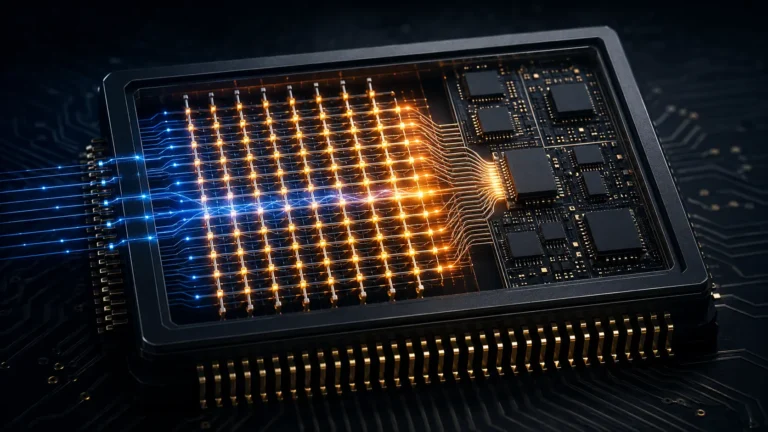
Analog in-memory computing is a semiconductor architecture that performs mathematical calculations directly inside data storage cells using physical electrical currents, bypassing the severe energy bottlenecks of traditional microchips.

A liquid neural network is a highly efficient artificial intelligence architecture that continuously rewrites its own internal mathematical equations in real time to adapt to unpredictable physical environments.

Fully homomorphic encryption is a mathematical architecture that allows computers to process and analyze data while it remains completely scrambled, ensuring cloud providers can calculate answers without ever seeing the actual information.
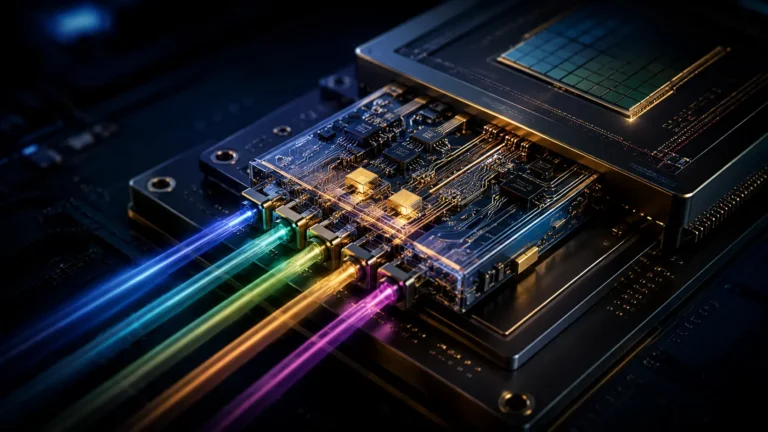
Silicon photonics is a hardware architecture that replaces traditional copper wires with microscopic lasers, allowing computer chips to transmit massive amounts of data across data centers using light instead of electricity.

Quantum error correction is a mathematical shield that groups thousands of unstable, error-prone quantum bits together to act as a single, perfectly reliable processor.

A robotics foundation model is a massive artificial intelligence system that translates visual data and human commands directly into physical movement, allowing machines to navigate the real world without hardcoded programming.

Post-quantum cryptography is a structural upgrade to the internet's core security infrastructure, replacing aging prime-number math with complex geometric grids to protect global data from future quantum computers.
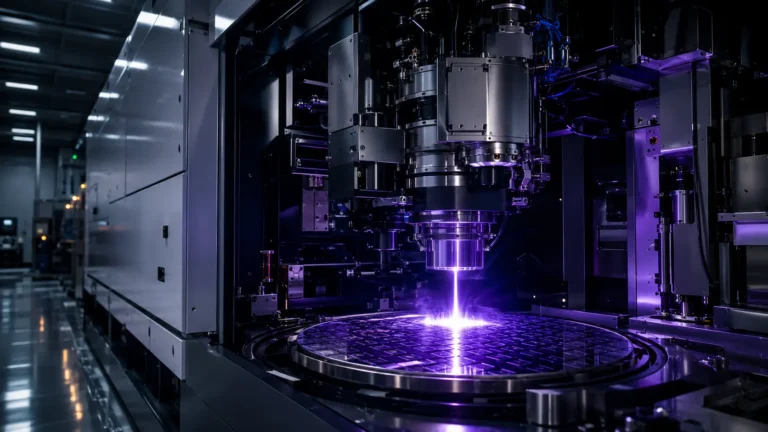
Extreme ultraviolet lithography is an incredibly complex manufacturing process that uses vaporized tin and perfectly polished mirrors to print microscopic circuits, relying on a single European company to sustain the entire global digital economy.

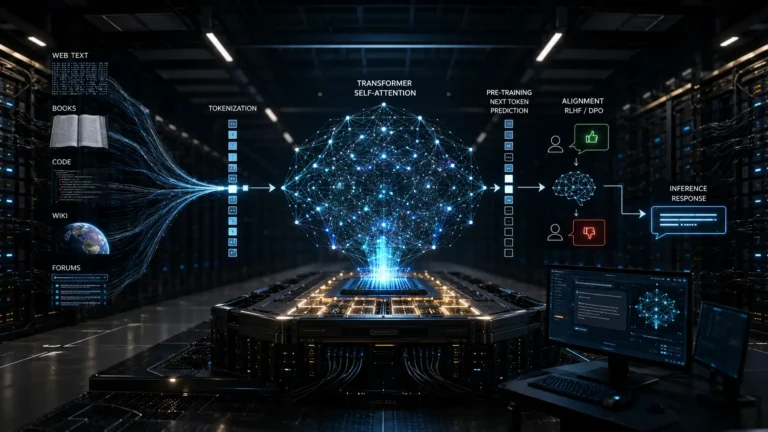
A large language model is a massive statistical engine that learns the mathematical patterns of human language by reading trillions of words and predicting the next logical word in a sequence.