
AT A GLANCE
- The Precision Failure: Only roughly 0.1% of an administered ADC dose successfully reaches the targeted diseased cells.
- Systemic Exposure: The remaining 99.9% of the drug circulates systemically, risking severe off-target toxicity.
- Clinical Attrition: Historically, 84% of ADC clinical trials terminate early in Phase I or II due strictly to intolerable safety issues.
- The Val-Cit Standard: Modern ADCs frequently utilize valine-citrulline dipeptide linkers engineered to cleave only under specific enzymatic conditions.
HOW IT WORKS (The Mechanism)
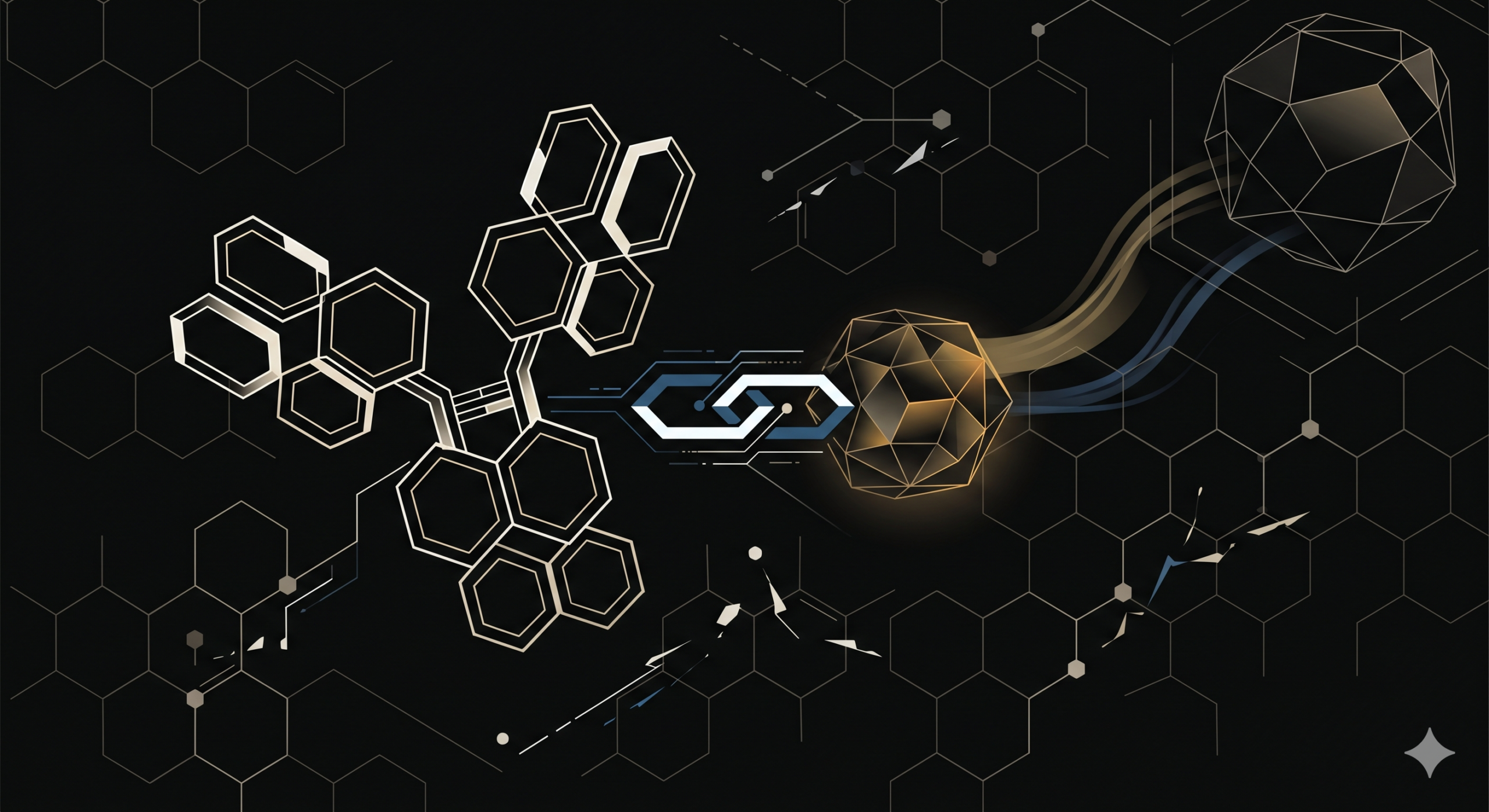
ADCs operate as tripartite chemical structures. A monoclonal antibody navigates the bloodstream. A linker molecule anchors to this antibody. A highly potent cytotoxic payload hangs directly from the linker.
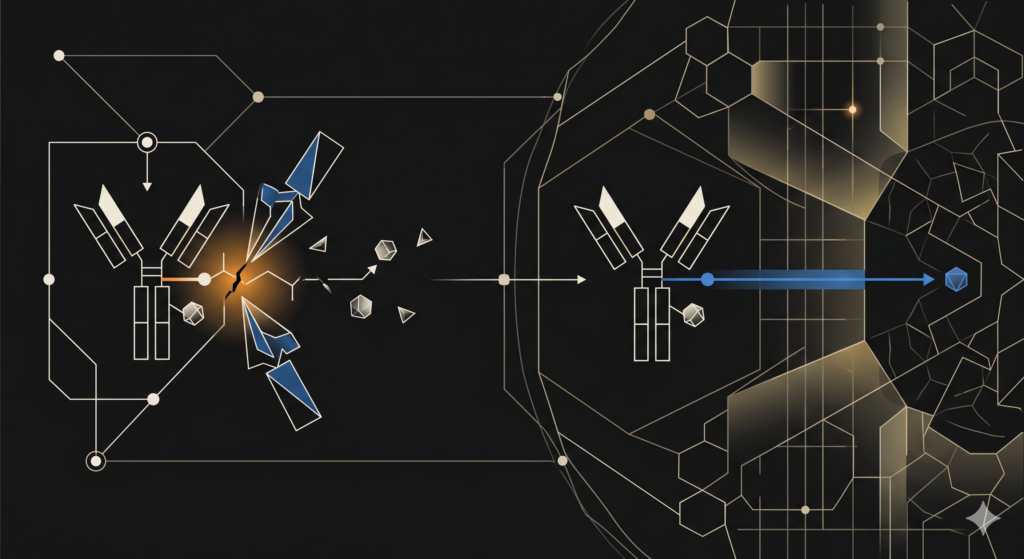
Engineers build two primary linker architectures. Cleavable linkers act as chemical triggers. They shatter instantly upon encountering acidic pH levels or specific enzymes inside tumor lysosomes.
Non-cleavable linkers utilize permanent thioether bonds. These bonds never break naturally. The target cell must entirely digest the antibody backbone to release the active drug payload.
WHY IT MATTERS NOW (The Human Impact)
Mainstream media sells the flawless “smart bomb” narrative. The clinical reality demonstrates brutal physics. If the chemical bridge lacks stability, the ADC prematurely sheds its payload directly into the bloodstream. This error turns a multi-billion dollar targeted therapy into an unguided systemic poison. First-generation ADCs utilized hydrazone linkers. These molecules hydrolyzed slowly in plasma. They caused massive off-target tissue damage and forced early drugs completely off the market. Biopharma investors now price early-stage oncology pipelines strictly on linker stability margins. A drug with perfect tumor targeting holds zero economic value if its linker drops the payload prematurely in the liver.
WHAT MOST PEOPLE MISS
Drug developers obsess heavily over the sheer toxicity of the payload. They ignore the molecular physics of the entire assembled structure. Highly potent payloads naturally repel water. They exhibit extreme hydrophobicity. When a linker bridges too many hydrophobic payload molecules to a single antibody, the entire structure clumps together in the blood. The human immune system flags this aggregated mass as a foreign threat. Macrophages immediately destroy it. Stability optimization requires engineering hydrophilic modifications, like PEGylation, to mask the payload and completely prevent immediate immune clearance.
THE TRAJECTORY (What Happens Next)
Over the next 12 to 36 months, developers will aggressively replace random conjugation methods with site-specific cysteine mutations. This shift locks the Drug-to-Antibody Ratio (DAR) into exact uniformity, mathematically eliminating the unstable, over-conjugated variants that currently cause massive systemic shedding.
KEY TERMS
- Drug-to-Antibody Ratio (DAR): The precise mathematical average of cytotoxic payload molecules physically attached to a single antibody.
- Bystander Effect: The process where a successfully released payload diffuses out of the target cell to kill neighboring, antigen-negative tumor cells.
- Cleavable Linker: A chemical bridge designed to break apart automatically when exposed to specific intracellular triggers like low pH or enzymes.
- Non-Cleavable Linker: A permanent molecular bond that requires the complete enzymatic destruction of the host antibody to release its cargo.
- Valine-Citrulline (Val-Cit): A highly common dipeptide sequence used in cleavable linkers, specifically targeted by lysosomal proteases.
SOURCES
- National Center for Biotechnology Information (PMC) – “Mechanisms of ADC Toxicity and Strategies to Increase ADC Tolerability” (2023).
- Technology Networks – “ADC Linker – Development and Challenges” (2024).
- Precise PEG LLC – “Key Factors in ADC Linker Chemistry” (2024).
- BOC Sciences – “ADC Linker Stability and Off-Target Toxicity” (2025).
RELATED TOPICS
- Read Next: The Ultra-Deepwater Blowout Preventer: Hydrostatic Pressure Dynamics and Containment Physics
- Read Next: The RTGS Architecture: Inside the FedWire Liquidity Matrix
- Read Next: The Separative Work Unit (SWU): The Kinetic Math of Uranium Enrichment Cascades
- Read Next: The Cis-Lunar Orbital Mechanics: The Industrial Real Estate War for Lagrange Points